Specimen sizes, and what the trade terms mean
Thumbnail, miniature, cabinet: the size categories are dealer conventions rather than standards. Knowing the ranges stops you buying something far smaller.
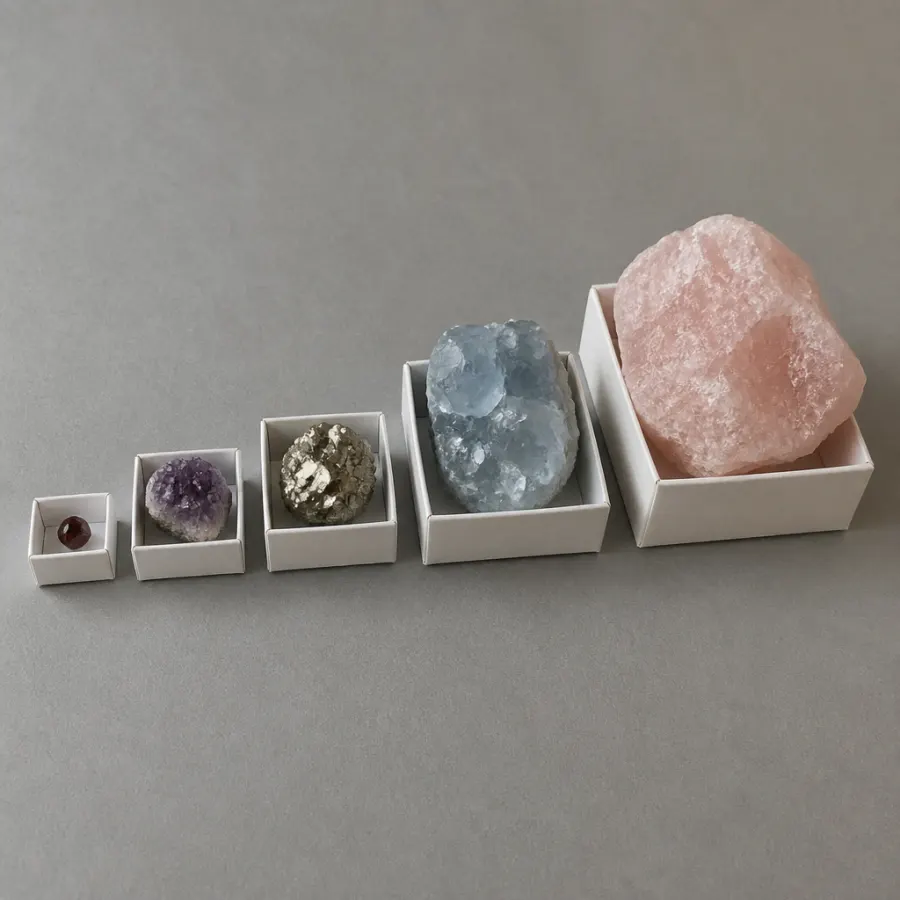
Thumbnail specimens fit a box of about 2.5 cm; miniatures run 3–5 cm, small cabinet 5–8 cm and cabinet 8–13 cm. These are trade conventions applied loosely, not defined standards, so read the stated measurement rather than the category. For Caldbeck and Leadhills material, small is simply what the locality produces.
In short
- Thumbnail: fits a 1 inch (about 2.5 cm) box.
- Miniature: roughly 3–5 cm.
- Small cabinet: roughly 5–8 cm. Cabinet: 8–13 cm+.
- These are conventions, applied loosely — always check the stated measurement, not the category.
- For some localities, small is the material. Caldbeck and Leadhills are thumbnail country.
| Term | Approx. size | Typical use |
|---|---|---|
| Micromount | Under 1 cm | Viewed under magnification only |
| Thumbnail | Fits a ~2.5 cm box | Rare species, small-crystal localities |
| Miniature | 3–5 cm | The most common collecting size |
| Small cabinet | 5–8 cm | Display |
| Cabinet | 8–13 cm | Display centrepieces |
| Museum | Above ~13 cm | Uncommon, priced accordingly |
Why the categories mislead
The terms are trade conventions rather than defined standards, and different dealers draw the lines in slightly different places. A 'miniature' from one seller can be noticeably smaller than another's.
The fix is simple: ignore the category and read the measurement. A reputable listing gives dimensions in centimetres, and if it does not, ask.
Small is not lesser
New collectors often equate size with quality, which leads them away from some of the best British material. Caldbeck Fells campylite, Leadhills linarite and most Mendip rarities are small by nature — a large piece is not a better specimen, it is usually a different and worse one.
Judge on crystal quality, colour, completeness and matrix rather than on bulk.
Photograph scale
Online, everything looks the same size. Always look for a stated measurement or a scale object, and be sceptical of images with no reference at all.
Macro photography flatters small specimens considerably — a millimetre crystal can fill a frame and look like a cabinet piece.