The Caldbeck Fells
A small area of northern Lakeland that produced some of the most distinctive lead secondaries in Britain: campylite from Dry Gill, and Roughton Gill too.
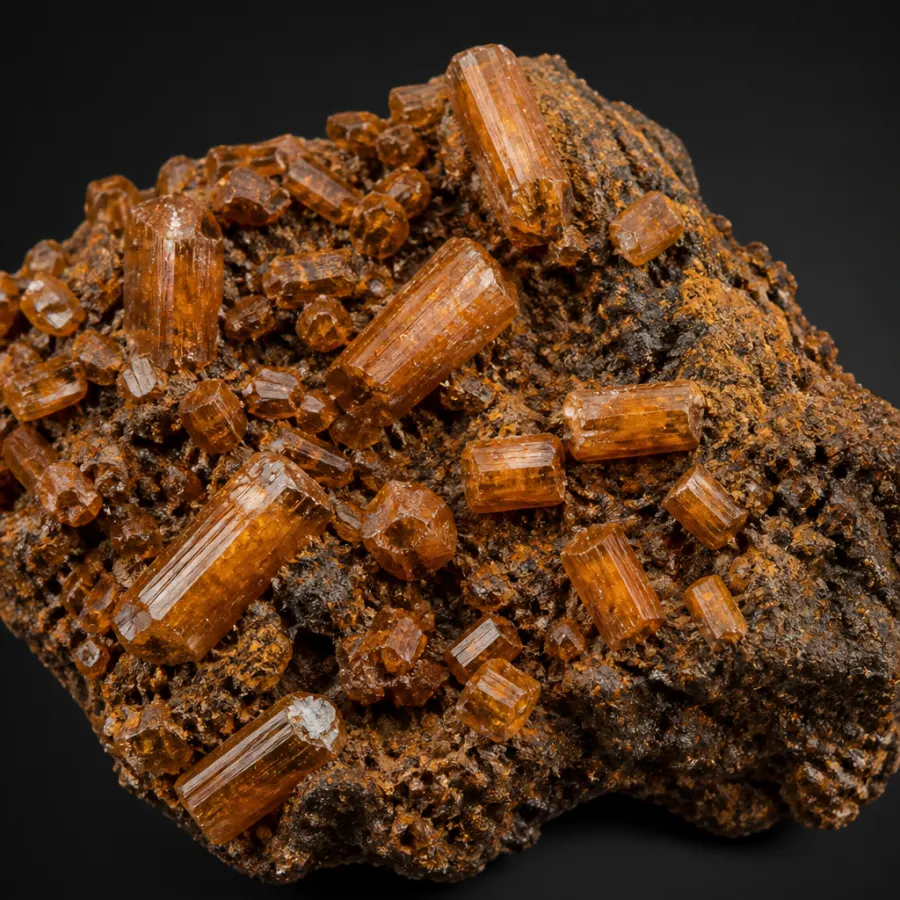
The Caldbeck Fells hold a remarkable density of old workings in a compact area of northern Cumbria, mined for lead and copper from the 1700s. Dry Gill produced campylite, the barrel-shaped arsenian mimetite that is the district's signature. Roughton Gill yielded pyromorphite, linarite and leadhillite. Specimens are small — typically under 5 cm.
In short
- The Caldbeck Fells are a compact area on the northern edge of the Lake District with a remarkable density of old workings.
- Campylite — the barrel-shaped, orange-brown arsenian variety of mimetite — is the signature material, classically from Dry Gill.
- Roughton Gill produced pyromorphite, linarite, leadhillite and plumbogummite.
- Nearly all material is old; the workings are long disused and largely within protected landscape.
- Specimens are small. This is thumbnail and miniature country, not cabinet.
| Working | Signature species | Character |
|---|---|---|
| Dry Gill | Campylite | Barrel-shaped orange-brown crystals on gossan |
| Roughton Gill | Pyromorphite, linarite, leadhillite | The most species-diverse of the group |
| Red Gill | Linarite, caledonite | Deep blue secondaries |
| Brandy Gill | Wolframite, arsenopyrite | Primary rather than secondary |
Campylite, and why it looks like nothing else
Campylite is not a separate species — it is the arsenian variety of mimetite — but it is visually distinctive enough that the old name has survived in the trade. The crystals are barrel-shaped rather than prismatic, typically warm orange to brown, and sit on a dark limonitic gossan that sets them off perfectly.
Dry Gill is the classic source, and a good Dry Gill campylite is one of the most recognisable British specimens there is.
Small, old, and finite
Two things constrain Caldbeck material. It is small — these are thumbnail and miniature specimens, and a genuinely large cabinet piece is exceptional. And it is old, because the workings have been disused for a very long time and the fells are within a protected landscape where collecting is not a matter of turning up with a hammer.
What circulates is therefore largely nineteenth and twentieth century collection material, which puts a premium on labels and documented provenance.
Roughton Gill's range
Roughton Gill is the more species-diverse of the two famous workings, producing pyromorphite in good greens, linarite in a deep blue that photographs badly and looks superb in hand, leadhillite, and plumbogummite — sometimes as pale blue coatings pseudomorphing pyromorphite, which is a Caldbeck speciality.