Pyromorphite
A lead phosphate that produces some of Britain's most distinctive specimens, including the barrel-shaped campylite of the Caldbeck Fells. Pb5(PO4)3Cl.
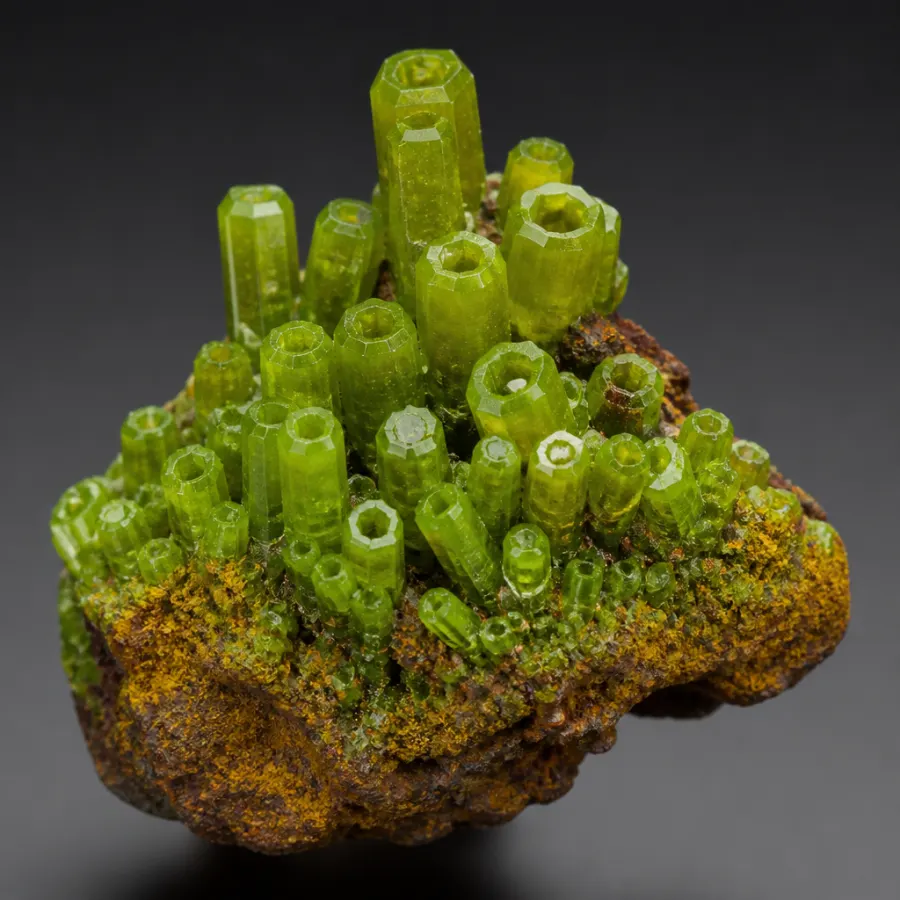
Pyromorphite is a lead chlorophosphate, hardness 3½–4, typically green but ranging to orange and brown. It forms a continuous series with mimetite, the arsenate, so intermediate compositions are common and labels sometimes disagree. Crystals are often hoppered — hollow down the prism axis — which is diagnostic and desirable.
In short
- Pyromorphite is a lead chlorophosphate, typically green but ranging to orange, brown and yellow.
- It forms a series with mimetite (the arsenate), and intermediate compositions are common.
- Campylite — the barrel-shaped arsenian mimetite of Dry Gill — sits at the mimetite end of that series.
- Classic British sources: the Caldbeck Fells and Roughton Gill.
- Crystals are often hollow or hopper-shaped, which is diagnostic and desirable.
| Pyromorphite | Mimetite | Campylite | |
|---|---|---|---|
| Anion | Phosphate | Arsenate | Arsenate (arsenian) |
| Typical colour | Green | Yellow to orange | Orange-brown |
| Habit | Hexagonal prisms, often hoppered | Prisms, globular | Barrel-shaped |
| Classic British site | Roughton Gill | Dry Gill | Dry Gill |
Hoppered crystals and why they matter
Pyromorphite frequently grows faster at the edges of a face than at the centre, producing crystals that are hollow down the prism axis — hoppered. Under a loupe the effect is striking, and it is a good confirmation of the species.
Hoppered material is generally more desirable than solid prisms, both visually and because it demonstrates the growth behaviour collectors associate with the species.
The series, and why labels disagree
Pyromorphite and mimetite form a continuous series, so a specimen may sit anywhere between the two end members. Without analysis, the assignment is often a judgement based on colour and habit.
That is why the same piece can carry different species names on different labels, and why 'campylite' persists as a trade term — it describes something visually specific regardless of where the chemistry lands.
Lead, and ordinary care
Pyromorphite is a lead mineral. It is safe in a cabinet and safe to handle. Do not grind, saw or dust it, wash your hands after handling, and keep it away from small children.
It is also soft at 3½–4, so it scratches against harder specimens in a shared drawer. Individual boxes are the answer.