Collecting
Practical guidance on buying, grading, cleaning and storing mineral specimens, and on the labels, provenance and condition questions that are worth asking.
Practical guidance for buying and keeping specimens. Thumbnails fit a box of about 2.5 cm, miniatures run 3-5 cm and cabinet pieces 8-13 cm. Most British material is 100 years old or more, so labels carry provenance and disclosed restoration is normal. Cleavage, not hardness, is what breaks a specimen in storage.
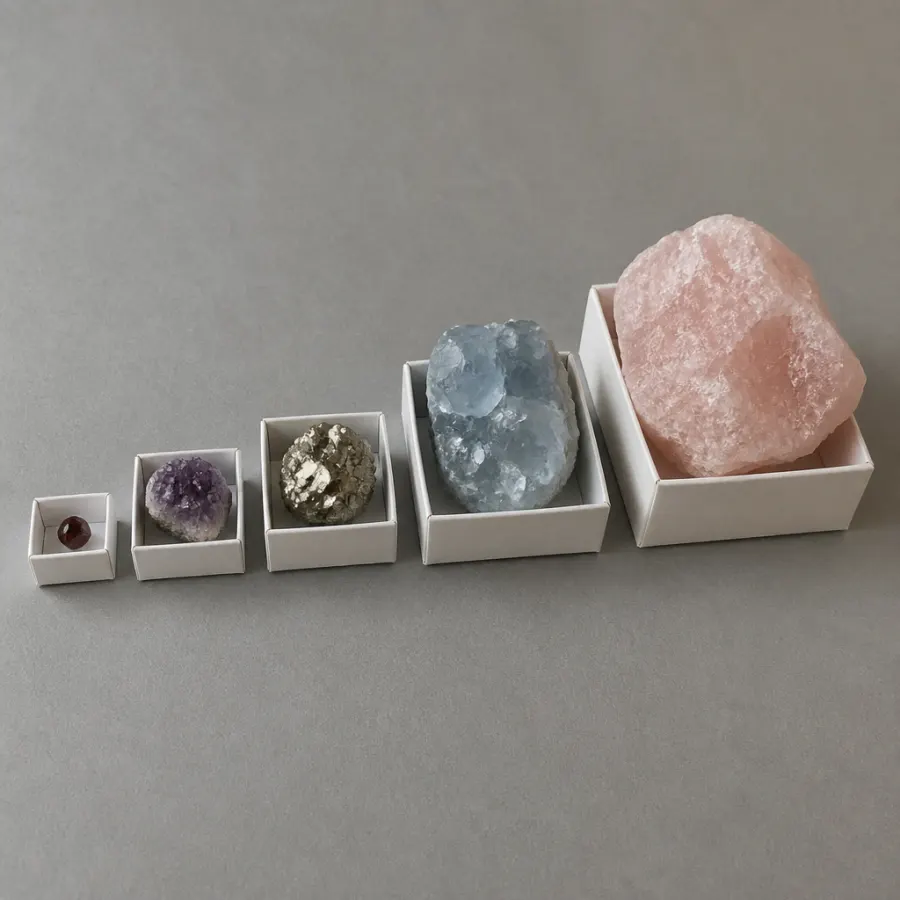
Specimen sizes, and what the trade terms mean
Thumbnail, miniature, cabinet: the size categories are dealer conventions rather than standards. Knowing the ranges stop…
Read →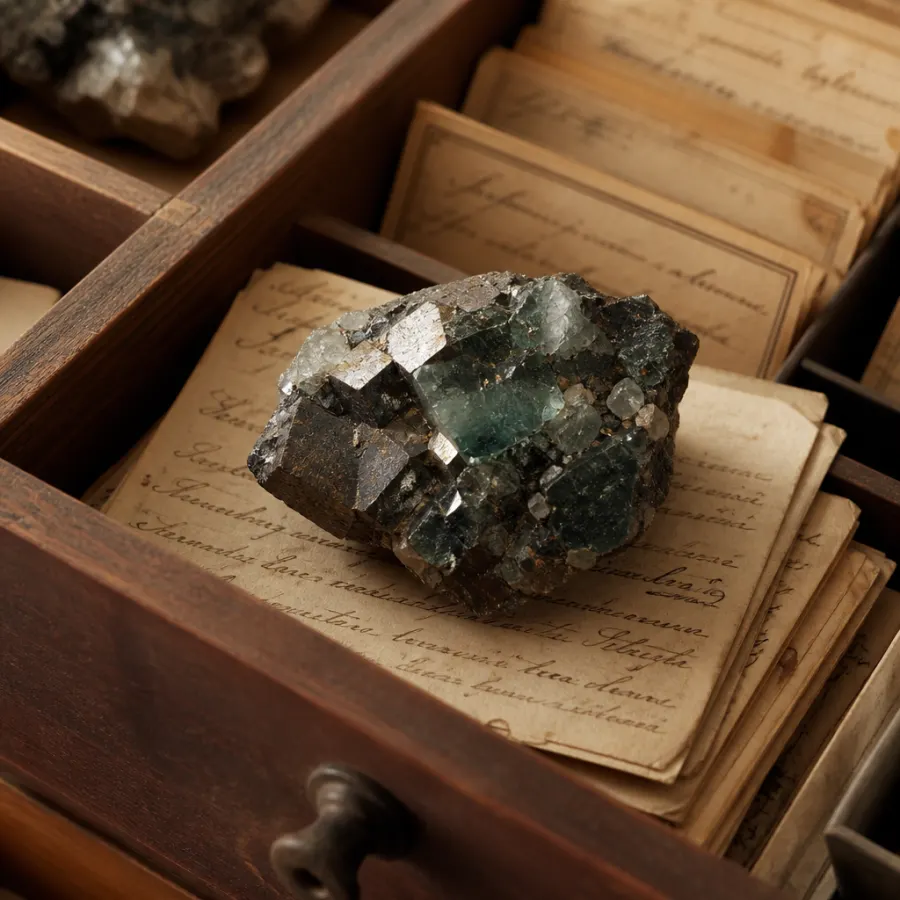
Buying old collection material
Nearly all classic British material is old, and that makes the label part of the value and restoration a normal question…
Read →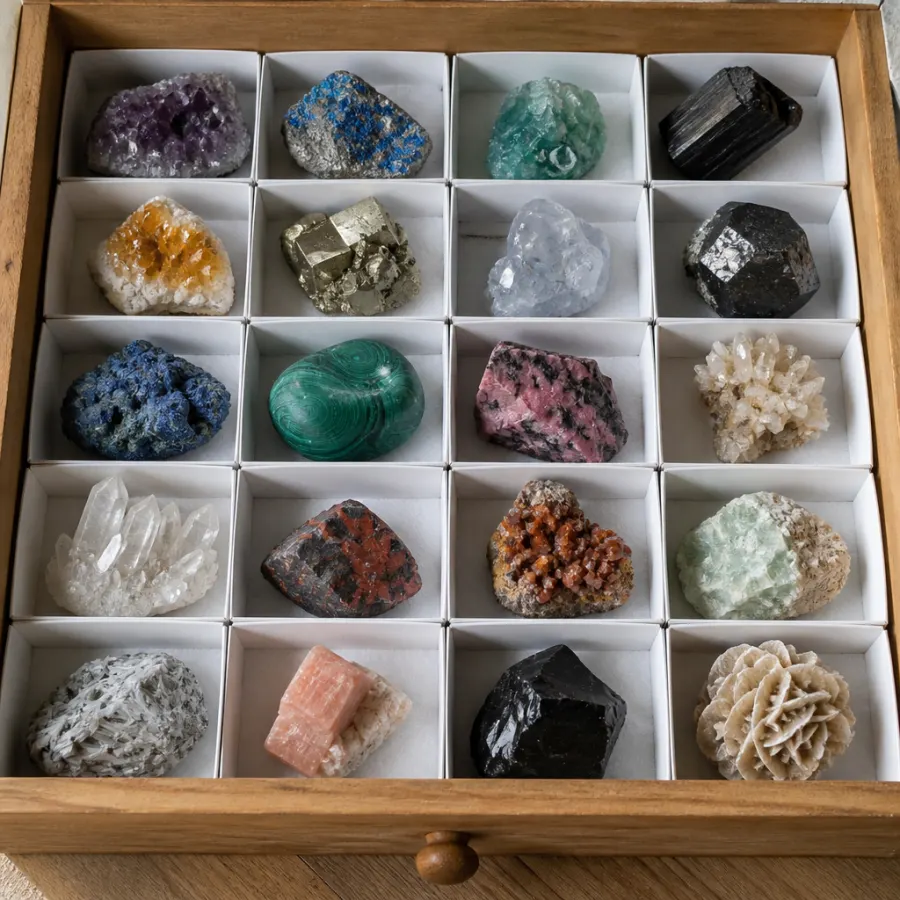
Handling and storing specimens
Most damage to a collection happens in a drawer, not out in the field. What actually threatens specimens — humidity, lig…
Read →What a fluorite specimen is worth
Locality, condition, crystal quality, colour and provenance, in roughly that order. Why no dealer can price fluorite by …
Read →How to identify a mineral specimen
Six tests you can run on a desk, in the order that eliminates the most possibilities fastest: habit, hardness, streak, c…
Read →Where to buy mineral specimens
Dealers, shows, auctions and online marketplaces each solve a different problem. What each one is good at, what it costs…
Read →Is my rock worth anything?
Usually not, and that is not a brush-off. What separates a specimen with real value from a heavy stone, and how to check…
Read →How to clean a mineral specimen
Water and a soft brush handle most of it. Quartz will tolerate almost anything and a soft arsenate crystal will not, and…
Read →Toxic minerals in a collection
Lead, arsenic, mercury, asbestiform fibres and uranium — what is genuinely dangerous on a shelf, what is not, and the on…
Read →Fluorescent minerals
Why some minerals glow, why the lamp matters far more than the rock does, why shortwave at 254 nm will burn your eyes, a…
Read →Why is my pyrite crumbling?
Pyrite decay is a chemical reaction, not a disease. Above 60% relative humidity a pyrite specimen oxidises to sulphates …
Read →Which minerals fade in light
Realgar, amethyst, green fluorite and the ruby silvers change irreversibly on a lit shelf. Which species are at risk, an…
Read →How to tell if a mineral specimen is repaired
Repair is normal in the mineral trade and undisclosed repair is not. A six-step inspection order, what raking light and …
Read →Is it legal to collect minerals in the UK?
Access is not permission and permission is not consent. Who owns the minerals, what a landowner can grant, and where the…
Read →Smithsonite vs hemimorphite
Two blue-green botryoidal zinc minerals from the same oxidised zones. Density separates them, acid settles it, hardness …
Read →What ex coll. means on a mineral label
Ex coll. is short for ex collectione, from the collection of. The abbreviations old labels use, and the three-part test …
Read →How to pack and ship mineral specimens
Double-box, 25 mm of soft padding on every face, and a gap that compresses. The packing order that survives a courier, a…
Read →How to tell if a crystal is fake or treated
Lab-grown chalcanthite, dyed howlite, aura quartz and glued clusters. What is manufactured, what is disclosed treatment,…
Read →“I inherited a mineral collection” — what to do first
Do nothing irreversible for 30 days. Photograph every specimen with its label, keep labels with their stones, and check …
Read →Is my mineral radioactive?
Fewer than 300 species carry uranium or thorium, and a label names most of them. Dust and radon matter more than direct …
Read →Why is my specimen growing a white crust?
Four different faults produce a pale crust, and the humidity causing each is different. Below 35% dehydration, above 60%…
Read →How to tell pyromorphite from mimetite
Both are hardness 3.5 to 4 and their densities differ by only 0.20. No hand test separates them, because they form a con…
Read →What is a type locality?
The locality a species was first described from, and where its type material was collected. Not the best locality, the o…
Read →Do I need a UV lamp for mineral collecting?
Mostly no. Longwave at 365 nm shows the least. Shortwave at 254 nm shows the most and needs eye protection. What each ba…
Read →What to look for when buying minerals online
Read the photographs before the description, and check the locality on the label. A UK dealer owes you 14 days to cancel…
Read →Is it safe to collect on old mine dumps?
Ground hazards hurt collectors long before the chemistry does. Never enter a shaft or adit on an old orefield, and get p…
Read →Where to sell a mineral collection
Six routes, and the honest crossover between them. A 400-specimen collection sold piece by piece is about 167 hours of w…
Read →How to display a mineral collection
An open shelf exposes a specimen to roughly 4,380 lit hours a year; a cabinet opened weekly, about 9. That 500-to-1 rati…
Read →How to label and catalogue a mineral collection
Five fields, one permanent number, three certainty states. The IMA list holds 6,239 valid species, so a name without its…
Read →Cleavage, parting or fracture: how to tell
Cleavage repeats, parting does not, fracture never repeats at all. Kyanite's two cleavages meet at 79 degrees; hema…
Read →What is a micromount?
A micromount is a specimen trimmed and mounted permanently in a small box to be viewed only under a microscope. It is a …
Read →How to store a mineral collection in a damp house
Air at 55% and 20 degrees is at 91.6% when it cools to 12 degrees overnight. That is why an afternoon hygrometer reading…
Read →What “self-collected” means on a mineral label
Self-collected asserts that a named person found the specimen at the named place. Four questions test it, and one of the…
Read →Is a specimen without a locality worth buying?
Sometimes, and the conditions are specific. A missing locality is permanent, so the question is whether you are buying s…
Read →How to start a mineral collection
Choose the size format before the species. One 120 by 30 cm shelf holds about 400 thumbnails or 16 cabinet specimens — a…
Read →Mineral specimen boxes and stands
Conservation guidance names clear polystyrene boxes, low-acid card trays, acid-free tissue and Plastazote. The enclosure…
Read →How to remove clay from a mineral specimen
Soak in deionised water, change it daily, and let time do the work. Hard brushing and compressed air break crystals, and…
Read →Why do mineral names end in -ite?
We machine-read the September 2026 IMA list: 5,988 of 6,195 names end in -ite, about 96.7%. The rules governing mineral …
Read →Choosing a microscope for mineral specimens
A stereo microscope at 10x to 40x is the right instrument. Depth of field falls from 55 micrometres at 4x to 1 micrometr…
Read →How to tell if a crystal is dyed
Dye pools in fractures and pores rather than following growth zones. Check colour distribution under a lens first: the d…
Read →How do I know if my rock is a meteorite?
Eliminate rather than confirm. One drag on a streak plate disposes of hematite, goethite and magnetite, which between th…
Read →How to test mineral hardness properly
Test on the base, wipe the mark, and look again. Kyanite is hardness 5.5 along the blade and 7 across it, so direction m…
Read →Best UV lamp for mineral collecting
Filtered 254 nm shortwave is the lamp that shows willemite, calcite and scheelite. Of 74 mineral species we checked, onl…
Read →Lighting a mineral display cabinet
Set a cabinet to 50 lux and the fading clock slows about threefold against 150 lux. A UV-free LED does not make amethyst…
Read →What is fool's gold?
Fool's gold is usually pyrite, hardness 6 to 6.5, density 5.018. Gold is hardness 2.5 to 3 and density 19.3, so it …
Read →How to store radioactive mineral specimens
Seal for dust, ventilate for radon. Store uranium species in rigid lidded boxes inside a vented cabinet, and survey the …
Read →Faded mineral labels
Thermal receipt paper goes blank entirely; felt tip and blue ballpoint fade in a lit cabinet within years. Photograph th…
Read →What ex-mine means on a specimen label
Ex-mine claims a specimen came out of the workings. For species the Handbook records as of post-mine formation, such as …
Read →How to photograph a mineral specimen honestly
Four disclosures make a specimen photograph honest: scale, axial light, the damage face, and unadjusted colour. Shoot th…
Read →What to expect at a mineral show
Give a show 3 hours minimum and spend the first one buying nothing. The walk-through costs nothing, and it is the stage …
Read →How to tell real turquoise from fake
Hardness separates turquoise from five of its six common substitutes and density from five. Faustite defeats both, and i…
Read →How to measure specific gravity at home
Weigh the specimen in air, then in water, and divide. The specimen must outweigh your scale's resolution by 150 tim…
Read →How to use a streak plate
Of 108 mineral species we checked, 78 record a streak and exactly half are white. Only quartz, topaz, corundum and schor…
Read →Mineral twinning explained
Twinning is recorded for 69 of the 108 mineral species we checked but called common for only 27. It is a fluorite cube i…
Read →What is a pseudomorph
A pseudomorph is one mineral in the crystal shape of another. Of 109 reference sheets we read, just one mentions the wor…
Read →Is autunite dangerous
Autunite is 49% uranium by mass and it crumbles on its own. Dehydration to meta-autunite costs it 18% of its volume, and…
Read →Why is my pyrite silver
Silver-coloured pyrite is usually marcasite, arsenopyrite or a surface film. A density ladder from 4.887 to 7.58 separat…
Read →How to value a mineral collection for insurance
An insurer pays on evidence, not on opinion. The four-document standard sets out what each specimen needs, and which spe…
Read →How to split rocks in the field
Of 109 mineral species this site covers, 57 cleave perfectly and only 15 do not. The specimen is usually weaker than the…
Read →How to clean pyrite safely
Salt is the most-suggested way to clean pyrite and the one that guarantees decay. Chloride plus pyrite makes hygroscopic…
Read →Is marcasite the same as pyrite?
Same formula, different species. Mohs cannot separate them — both 6 to 6.5 — but the Vickers number can: marcasite 915 t…
Read →Is arsenopyrite dangerous?
Arsenopyrite is FeAsS — 46.01% arsenic by mass. It is stable on a shelf and the exposure route is preparation: sawing, g…
Read →How to store soluble mineral specimens
Halite fails above 75.3% humidity, chalcanthite below 35% and pyrite above 60%. The only band that suits all three cryst…
Read →How do mineral specimens form?
41 of the 109 species here are described as secondary or as forming in the oxidised zone. Most display material grew fro…
Read →How to remove iron stain from a specimen
Oxalic acid strips iron stain and attacks 43 of the 109 species here, which contain carbonate, lead or calcium. Read the…
Read →UV torch or lamp for minerals?
A torch lights 10 to 62 square centimetres at 20 cm; a 25 cm tube about 625. Coverage, not power, separates the two, and…
Read →Is realgar safe to handle
Realgar is 70.03% arsenic by mass and hardness 1.5 to 2. The risk is not touching it: it turns itself into arsenic-rich …
Read →What is a gossan
A gossan is the iron-stained leached cap over a weathered sulphide orebody. The word is on none of 158 species sheets in…
Read →Is fluorite UV reactive
Fluorite gave fluorescence its name and its Handbook sheet lists five emission colours, more than any other species. It …
Read →Is malachite toxic
Malachite is 57.48% copper by mass, hardness 3.5 to 4 and a carbonate. A solid specimen is inert. Cutting, tumbling and …
Read →Is magnesite the same as howlite
No. Magnesite is a carbonate at density 3.00, howlite a borosilicate at 2.53 to 2.59. Both are dyed blue and sold as tur…
Read →Is olivine the same as peridot
Peridot is gem-quality magnesium-rich olivine. Olivine itself is a series name, spanning forsterite at density 3.275 and…
Read →How to clean fluorite safely
Fluorite is hardness 4 with perfect cleavage on four planes, so no direction of applied force lies more than 54.74 degre…
Read →How to remove calcite from a specimen
Only 4 of 158 mineral sheets mention acid at all. The reference literature will not tell you what survives, so classify …
Read →Is galena toxic
Galena is PbS, 86.60% lead by mass, hardness 2.5 to 2.75, with perfect cubic cleavage. An intact crystal is the easy cas…
Read →Is amazonite radioactive
Amazonite is green microcline, KAlSi3O8, 14.05% potassium. Natural potassium is 0.0117% potassium-40, so it is weakly ra…
Read →Is smithsonite UV reactive
Smithsonite may fluoresce pale green or pale blue, its Handbook sheet says, naming no UV band. It is one of 12 such shee…
Read →Is scapolite fluorescent
Scapolite is a group, not a species. Both its sheets say it commonly fluoresces orange to bright yellow or red, LW or SW…
Read →Is aragonite the same as calcite
No. Both are CaCO3, but aragonite is orthorhombic at density 2.95 and calcite hexagonal at 2.7102. On a 50 g piece that …
Read →How to identify feldspar
Six steps, in order: cleavage flash, hardness 6 to 6.5, a near-90 degree angle, density under 2.8, striations, context. …
Read →Is tetrahedrite magnetic
The three tetrahedrite-group Handbook sheets record no magnetism. 5 of 176 sheets record any. If your specimen pulls a m…
Read →What is a double terminated crystal
A crystal with natural faces at both ends, because neither end was attached as it grew. A growth habit, not a twin; 1 of…
Read →Which minerals are magnetic
Of 176 Handbook of Mineralogy sheets, 5 record a magnetic property: magnetite, pyrrhotite, greenalite, pyrite and borax.…
Read →Which minerals are zeolites
Zeolites are open tetrahedral frameworks holding loose water; the IMA accepted 82 in 1997. 9 of 176 Handbook sheets say …
Read →What does botryoidal mean
Botryoidal means shaped like a bunch of grapes: rounded masses, often fibrous inside. A habit, not a species; 25 of 176 …
Read →Is baryte toxic
Baryte is barium sulphate, 58.84% barium, and does not easily dissolve, which is why ATSDR says it causes few harmful ef…
Read →Is chrysocolla the same as turquoise
No. Chrysocolla is a copper silicate, hardness about 2 to 4, density 1.93 to 2.4; turquoise is a copper aluminium phosph…
Read →Is rhodochrosite the same as rhodonite
No. Rhodochrosite is manganese carbonate, hardness 3.5 to 4; rhodonite is a manganese silicate at 5.5 to 6.5. Their dens…
Read →Is hemimorphite the same as larimar
No. Larimar is the trade name of blue pectolite from the Dominican Republic. Both are hardness 4.5 to 5, but density spl…
Read →How to tell calcite from quartz
Hardness first: calcite is 3 and quartz 7, four Mohs points apart. Then rhomb cleavage against conchoidal fracture. Dens…
Read →Why did my fluorite break
Fluorite is hardness 4 with perfect cleavage on four planes. A flat, bright break on a specimen is cleavage; a rough one…
Read →Why is my malachite dull
Massive malachite is dull by nature, its Handbook sheet says. Otherwise: wear at hardness 3.5 to 4, acid on a carbonate,…
Read →Is vivianite light sensitive
Vivianite darkens, but its Handbook sheet says oxidation, not light. 7 of 176 sheets record a light response and viviani…
Read →Is adamite UV reactive
Adamite may fluoresce and phosphoresce lemon-yellow under SW and LW UV, its Handbook sheet says. In a 1948 test 2 of 7 l…
Read →Is chalcopyrite the same as peacock ore
Sometimes. Peacock ore is a trade name for bornite and for acid-tarnished chalcopyrite. A fresh surface decides: brass-y…
Read →Is celestite a quartz
No. Celestite, IMA name celestine, is strontium sulphate, hardness 3 to 3.5, density 3.97; quartz is silica at 7 and 2.6…
Read →Is cinnabar toxic
Cinnabar is mercury sulphide, HgS, 86.22% mercury by mass, hardness 2 to 2.5. The form changes the answer: solid, dust, …
Read →Is dioptase the same as emerald
No. Dioptase is copper silicate, hardness 5, density 3.28 to 3.35, green streak; emerald is green beryl at 7.5 to 8 and …
Read →Why is my selenite turning yellow
Selenite is gypsum, hardness 1.5 to 2, clear unless impurities colour it. On a specimen, yellow or black, flaking and ch…
Read →Is selenite water soluble
Selenite is gypsum, and a crystal dissolves slightly: 0.24 g per 100 ml of water at 25 °C. That is about 171 times calci…
Read →Is scolecite asbestos
UK law defines asbestos as six named fibrous silicates. Scolecite, a zeolite of hardness 5 to 5.5, is not among them, th…
Read →Why is my amethyst losing color
Amethyst is quartz, hardness 7, a crystal coloured by iron that radiation altered. Strong light fades it; 400 to 500 °C …
Read →How to tell if fluorite is real
A fluorite crystal is hardness 4, density 3.175 to 3.184, cubic. Of 176 Handbook sheets only fluorite passes all three. …
Read →How to tell if malachite is real
A malachite specimen has a density of 4.05, so a 20.00 g piece weighs 15.06 g in water; 3.6 is the floor. Then check the…
Read →Is apophyllite a zeolite
No. A zeolite has an open framework of linked tetrahedra (IMA, 1997). Apophyllite is a group of six species that grows b…
Read →Is labradorite a moonstone
Not strictly. GIA calls moonstone orthoclase layered with albite; labradorite is a calcic plagioclase at density 2.68 to…
Read →Crystal vs mineral: what is the difference
A mineral is a natural, ordered solid of definite composition; a crystal is one grain with its own faces. Quartz is a mi…
Read →How to tell if amethyst is real
Amethyst is quartz, hardness 7, a crystal that reads 1.544 and 1.553 on a refractometer. Glass reads once and shows bubb…
Read →How to tell if labradorite is real
Real labradorite flashes from inside the stone at set angles, with straight-edged colour zones and hardness 6 to 6.5. La…
Read →Why is my labradorite turning black
Labradorite flashes only at certain angles to the light, and some has a near-black body colour. At hardness 6 to 6.5, du…
Read →Is chrysocolla the same as malachite
No. Chrysocolla is a copper silicate, density 1.93 to 2.4; malachite a copper carbonate, density 4.05. They grow togethe…
Read →Is actinolite asbestos
UK law names asbestos actinolite. HSE's analysts' guide lists plain actinolite as its non-asbestos analogue, s…
Read →Is calcite UV reactive
Calcite may fluoresce red, blue, yellow and more under shortwave and longwave UV; it is the only one of 176 reference sh…
Read →Is smithsonite the same as aragonite
No. Smithsonite is zinc carbonate, density 4.43; aragonite is calcium carbonate, 2.95. A 20 g piece weighs 15.49 g or 13…
Read →Is rhodochrosite magnetic
Not strongly. Its sheet records no magnetism; USGS pulled rhodochrosite at 0.10 to 0.60 amp, paramagnetic, where magneti…
Read →How to tell if tourmaline is real
Real tourmaline looks darker down its length and gives two refractometer readings about 0.020 apart, near 1.62 to 1.67. …
Read →Is tourmaline a quartz
No. Quartz is SiO2; tourmaline is a boron ring silicate, 34 to 38% silica by mass. Both are hardness 7; quartz is striat…
Read →How to tell tourmaline from obsidian
Black tourmaline is a crystal, density 3.18 to 3.22; obsidian is volcanic glass, usually 2.33 to 2.42. A 20 g piece read…
Read →Is apatite fluorescent
Often. The fluorapatite sheet says it may fluoresce in UV. Manganese gives yellow, rare earths blue, white or pink (Modr…
Read →Is galena magnetic
No. The galena sheet records no magnetism, and USGS found 9 of 9 galena samples unpulled at 1.70 amp. In a galena specim…
Read →Why did my pyrite break
A bright, curved break on clean pyrite is a knock: pyrite is brittle, hardness 6 to 6.5, with no good cleavage. Powder, …
Read →How to tell if rhodonite is real
Real rhodonite is rose-pink, often black-veined, hardness 5.5 to 6.5, and a polished piece reads near 1.73 on a refracto…
Read →Is rhodonite a garnet
No. Rhodonite is a triclinic manganese silicate with two cleavages at 92.5 degrees. Garnets such as spessartine are cubi…
Read →How to tell if pyrite is real
A real pyrite specimen is a brass-yellow sulphide, hardness 6 to 6.5, streak greenish black. A solid 8 mm pyrite bead we…
Read →Is quartz a mineral?
Quartz is a mineral species: SiO2, hardness 7, density 2.65. Eight IMA rows share the formula SiO2, and cultured quartz …
Read →Is gypsum a mineral?
Gypsum is a mineral species, CaSO4·2H2O, hardness 1.5 to 2. Calcined, it becomes plaster of Paris: the formula of the mi…
Read →Is lapis lazuli a mineral or a rock?
Lapis lazuli is a rock: GIA calls it an aggregate of lazurite, calcite and pyrite. Lazurite is the mineral, hardness 5 t…
Read →Ludlamite vs vivianite
Two iron phosphate species, same mines. Ludlamite crystals are green, hardness 3.5; vivianite is soft, 1.5 to 2, and oxi…
Read →Stannite or cassiterite
Stannite is a steel-grey tin sulphide, hardness 4, with a blackish streak. Cassiterite is tin oxide, hardness 6 to 7, de…
Read →Is stibnite magnetic
No. Stibnite's sheet records no magnetism, and USGS left 6 of 6 samples of this antimony sulphide unpulled at 1.70 …
Read →How to tell if rhodochrosite is real
Real rhodochrosite, manganese carbonate, is pink to rose-red, hardness 3.5 to 4, and a 20 g piece weighs at least 14.12 …
Read →How to tell if citrine is real
Real citrine is yellow quartz, hardness 7, refractive index 1.544 to 1.553, unlike topaz. GIA says most citrine sold is …
Read →How to tell if aquamarine is real
Real aquamarine is blue beryl, the species of emerald: hardness 7.5 to 8, two refractometer readings under 1.60. Blue to…
Read →Is chrysoberyl the same as alexandrite?
No: alexandrite is the colour-change variety of chrysoberyl, BeAl2O4, hardness 8.5. Every alexandrite is chrysoberyl, no…
Read →Is fluorite the same as fluoride?
No. Fluorite is a mineral, CaF2, hardness 4; fluoride is the fluorine ion and its compounds. Fluorite is 48.67% fluorine…
Read →Is siderite magnetic?
Siderite, FeCO3, is not magnetic like magnetite: USGS pulled 17 samples at 0.10 to 0.50 amp. Of 16 anhydrous carbonates,…
Read →What is a phantom crystal?
A phantom crystal shows its own earlier faces, coated by another mineral and overgrown. The GIA same-axis test separates…
Read →Is obsidian a mineral?
Obsidian is not a mineral: it is natural volcanic glass with no crystal structure, typically 66 to 72% SiO2 by mass. The…
Read →Is amber a mineral?
Amber is not a mineral: GIA classes it as organic fossilised resin, amorphous, hardness 2 to 2.5, specific gravity 1.08.…
Read →Is zircon a diamond?
No. Zircon is Zr(SiO4), hardness 7.5; diamond is carbon, hardness 10. Of 12 diamond names on a gem society list of false…
Read →Is topaz a quartz?
No. Topaz is Al2SiO4F2, hardness 8; quartz is SiO2, hardness 7. Of nine topaz names on a gem society list of false names…
Read →How to tell if garnet is real
Real garnet is cubic: one refractometer reading, 1.714 to 1.888 on GIA's range, hardness 6.5 to 7.5. Glass reads 1.…
Read →How to tell if topaz is real
Topaz crystals are striated along their length and cleave across it; quartz is striated across. Hardness 8; readings 1.6…
Read →Is arsenopyrite magnetic?
Arsenopyrite, FeAsS, is not magnetic like magnetite: its USGS best range is above 1.70 amp. Of 18 arsenic species tabled…
Read →Is torbernite radioactive?
Yes. Torbernite, a secondary copper uranyl phosphate, is radioactive on its Handbook sheet, and by mass it is 47.15% ura…
Read →How mineral auctions work
How a mineral auction works for a specimen or a collection: consignment, reserve, the hammer, buyer’s premium on 100 uni…
Read →Is hemimorphite UV reactive?
Sometimes: the Handbook says hemimorphite, a secondary zinc silicate, may fluoresce bluish under shortwave UV. Six of th…
Read →Is benitoite fluorescent?
Yes: the Handbook records blue fluorescence under shortwave UV. Laurs et al. found blue crystals inert under longwave an…
Read →Is mimetite UV reactive?
Sometimes: mimetite may fluoresce reddish yellow under LW or SW UV, its Handbook sheet says. Of the three Pb5(XO4)3Cl mi…
Read →Is opal a mineral?
Opal has an IMA row, SiO2·nH2O, status G. Its structure varies: of 236 opals X-rayed in a 2019 review, 67 were amorphous…
Read →Is chalcedony quartz?
Chalcedony is quartz with crystals too small to see: hardness 7, SG 2.55 to 2.91 (IGS), no IMA row. Mexican onyx is calc…
Read →Is jade a mineral?
Jade is two rocks, not one mineral: jadeite (hardness 6 to 7) and nephrite, a tremolite-actinolite amphibole. Quartz, ca…
Read →How to tell if jade is real
Real jade is jadeite (SG 3.34) or nephrite (2.95); over 13.98 g in water for 20 g fits jadeite. Quartz and prehnite pass…
Read →Is prehnite a zeolite?
Prehnite is not a zeolite. Its IMA formula groups (Si3Al)O10, 2.5 oxygens per tetrahedral atom, as in muscovite; all 13 …
Read →Is malachite magnetic?
Malachite is not magnetic like magnetite: USGS pulled 7 samples at 0.20 to 1.40 amp, moderately paramagnetic. Of 30 copp…
Read →Is labradorite a feldspar?
Yes. Labradorite is plagioclase feldspar, An50 to An70, hardness 6 to 6.5. Worked from its Handbook analysis, San Marcos…
Read →Is moonstone a mineral?
No. Moonstone is a gem name, not an IMA species: GIA calls it orthoclase and albite in layers about 0.5 micron thick, ha…
Read →Is spodumene a pyroxene?
Yes. Spodumene, LiAlSi2O6, is a monoclinic pyroxene, hardness 6.5 to 7, the lone Li pyroxene of the 1988 IMA report. Vir…
Read →Is sodalite the same as lapis lazuli?
No. Sodalite is a mineral, density 2.27 to 2.33, white streak, no pyrite; lapis is a rock, GIA SG 2.50 to 3.00. In water…
Read →Is sodalite UV reactive?
Yes: its Handbook sheet records bright red-orange fluorescence under LW and SW UV. In GIA tests all 16 sodalite stones g…
Read →Natrolite vs scolecite
Natrolite and scolecite crystals share hardness, cleavage and weight. Optics split them: natrolite below 1.50, straight …
Read →Is serpentine jade?
Serpentine is not jade to GIA: it is antigorite, lizardite or chrysotile, Mg3Si2O5(OH)4, hardness 2.5 to 3.5. New Zealan…
Read →How to tell if opal is real
To tell if opal is real, look side-on first: GIA shows a triplet by its seam. Gilson synthetic is opal made in a lab; pl…
Read →How to tell if lapis lazuli is real
For collectors: look first, weigh second, then ask a lab. Three of five named lapis imitations weigh inside GIA’s range;…
Read →Is fuchsite a mica?
Fuchsite is mica: the IMA mica report files it under chromian muscovite, and the IMA list has no fuchsite row. The 10-to…
Read →Is chrysoberyl a beryl?
Chrysoberyl is not a beryl: BeAl2O4, an oxide, against beryl’s Be3Al2(Si6O18). It has 1.41 times beryl’s BeO by mass, an…
Read →Is tiger’s eye asbestos?
Tiger’s eye is quartz, hardness 7, tied to crocidolite, the blue asbestos UK law names. How its fibres sit is disputed. …
Read →