Handling and storing specimens
Most damage to a collection happens in a drawer, not out in the field. What actually threatens specimens — humidity, light, pyrite decay — and the fixes.
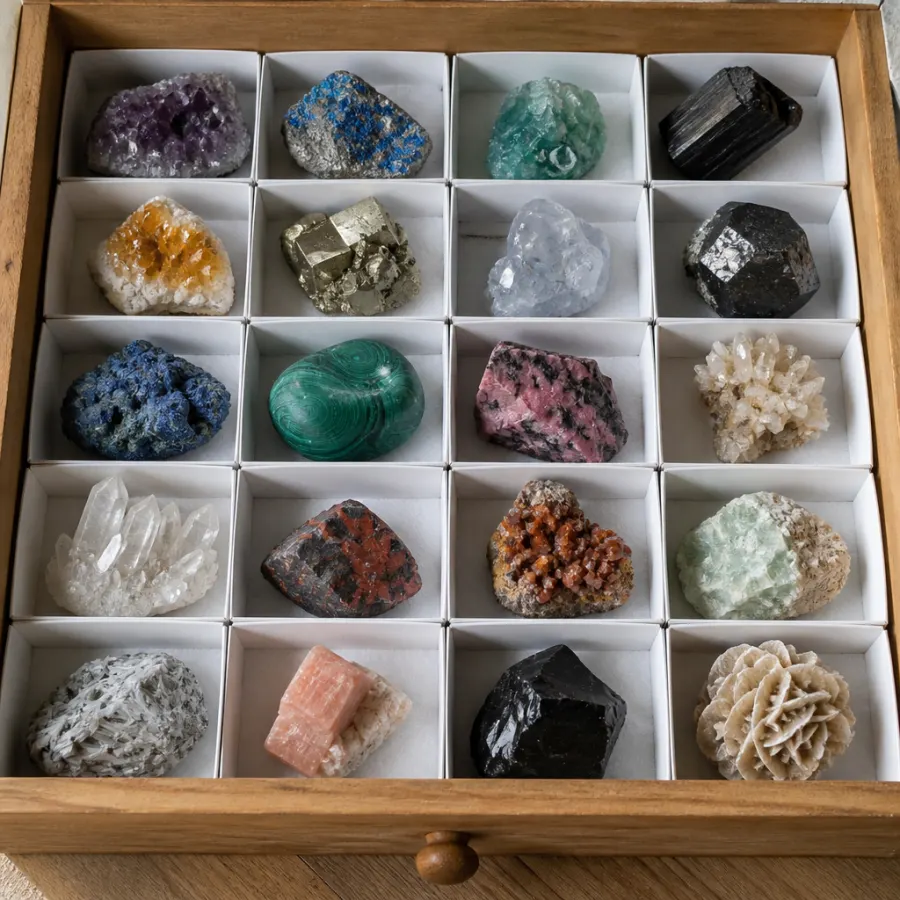
Most damage happens in a drawer, not in the field. Store specimens in individual boxes, out of direct sunlight, in stable dry conditions. Cleavage rather than hardness is what breaks them: fluorite at hardness 4 has perfect cleavage in 4 directions and still loses corners. Lead and arsenic species are safe in a cabinet.
In short
- Individual boxes. Loose specimens in a shared drawer scratch and chip each other.
- Light fades some species — keep vulnerable material out of direct sunlight.
- Humidity matters: some sulphates and halides are hygroscopic or degrade in damp.
- Cleavage, not hardness, is what breaks specimens. Fluorite is hard enough and still chips.
- Lead and arsenic species are safe in a cabinet — do not grind or dust them, and wash your hands.
| Risk | Affects | What to do |
|---|---|---|
| Mechanical damage | Everything | Individual boxes; never wedge or lever |
| Cleavage fracture | Fluorite, calcite, barite | Support the specimen, not the crystal |
| Light fading | Some coloured species | Out of direct sunlight |
| Humidity | Sulphates, some halides | Stable, dry storage |
| Dust | Fibrous and acicular species | Do not brush; use air if anything |
| Handling residue | Soft species | Handle by matrix, not crystals |
Cleavage is the real enemy
Collectors think in hardness, but breakage is usually about cleavage. Fluorite at hardness 4 will scratch a fingernail comfortably and still lose a corner to a knock, because it parts cleanly along octahedral planes.
The practical rule: support the matrix, never the crystal, and never lever a specimen out of a tight box. Most damage happens in the two seconds of getting a piece in or out of storage.
Light, and which species care
Not everything fades, but enough does to make direct sunlight a bad default. Some coloured species lose intensity irreversibly with prolonged exposure.
Display is a trade-off you make knowingly: a cabinet by a window looks better and costs you something over years. If a piece is irreplaceable, keep it out of the light.
Lead and arsenic, in proportion
A great deal of classic British material is lead- or arsenic-bearing — pyromorphite, mendipite, scorodite, olivenite, clinoclase. These are safe in a cabinet and safe to pick up.
The precautions are ordinary and worth taking anyway: do not grind, saw or dust them, do not eat while sorting a collection, wash your hands afterwards, and keep specimens where small children cannot help themselves.