Fluorite
The most collected British mineral, and the one where locality does most of the work in setting a price. CaF2, hardness 4, perfect octahedral cleavage.
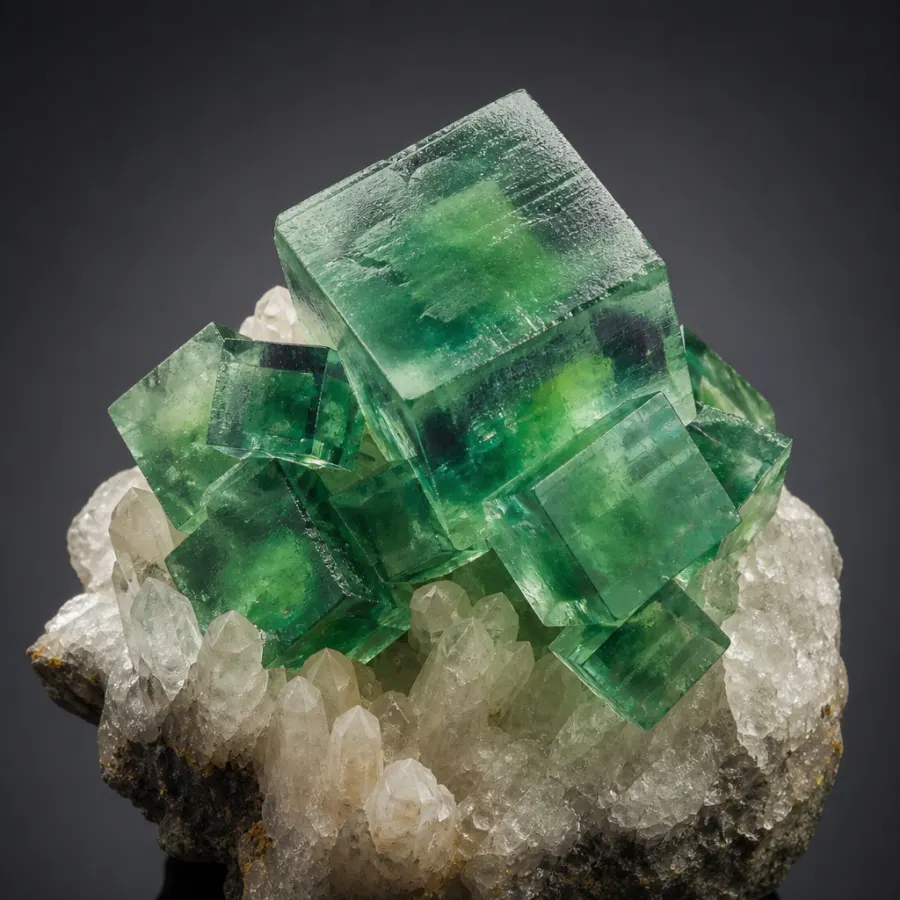
Fluorite is calcium fluoride, hardness 4, with perfect octahedral cleavage in four directions — it chips far more easily than quartz. Britain's great fluorite is the North Pennine orefield, where Rogerley material fluoresces blue in daylight. Derbyshire runs purple and amber, and gives us Blue John, the banded ornamental variety.
In short
- Fluorite is calcium fluoride, hardness 4, with perfect octahedral cleavage — it chips easily.
- Britain's great fluorite is the North Pennine orefield: Weardale green, including daylight-fluorescent Rogerley material.
- Derbyshire runs purple and amber, and gives us Blue John, the banded ornamental variety.
- It gave its name to fluorescence, though not all fluorite fluoresces.
- Cleavage is the practical issue: never wedge or lever a fluorite specimen.
| Locality | Typical colour | Distinguishing feature |
|---|---|---|
| Rogerley, Weardale | Green | Daylight fluorescence — blue in sunlight |
| Boltsburn, Weardale | Green to amber | Large lustrous crystals; historic |
| Milldam, Derbyshire | Purple, amber | Modern specimen source |
| Castleton, Derbyshire | Banded purple/white | Blue John — ornamental, not crystals |
| Cornwall | Green, purple | Subordinate to the copper species |
| Alston Moor | Green, purple | With the barium suite |
Cleavage is the thing to understand
Fluorite has perfect cleavage in four directions, which means it parts cleanly along octahedral planes under quite modest force. A knock that would leave a quartz crystal untouched can take a corner off a fluorite.
Practically: never lever a fluorite specimen out of a box, never wedge it against another piece in a drawer, and support the specimen rather than the crystal when handling. Most damage happens in storage and transport, not in the field.
Fluorescence, and the Rogerley exception
Fluorite gave fluorescence its name, but the property is variable — plenty of fluorite does not fluoresce at all, and the colour when it does depends on trace elements rather than the fluorite itself.
Rogerley material is the exception worth knowing: it fluoresces strongly enough that ordinary daylight excites it, so the crystals read blue outdoors and green indoors. That is unusual and it is the reason the mine became internationally known.
Colour is not a reliable locality guide
Green fluorite is not automatically Weardale and purple is not automatically Derbyshire. Colour zoning within a single crystal is common, and both counties produced both.
Judge locality on habit, matrix and association — and on the label. This is a species where a documented provenance is doing real work.