Cornwall
Two centuries of copper and tin mining left Cornwall with a mineral suite few regions anywhere can match, and a set of mine names that still set prices.
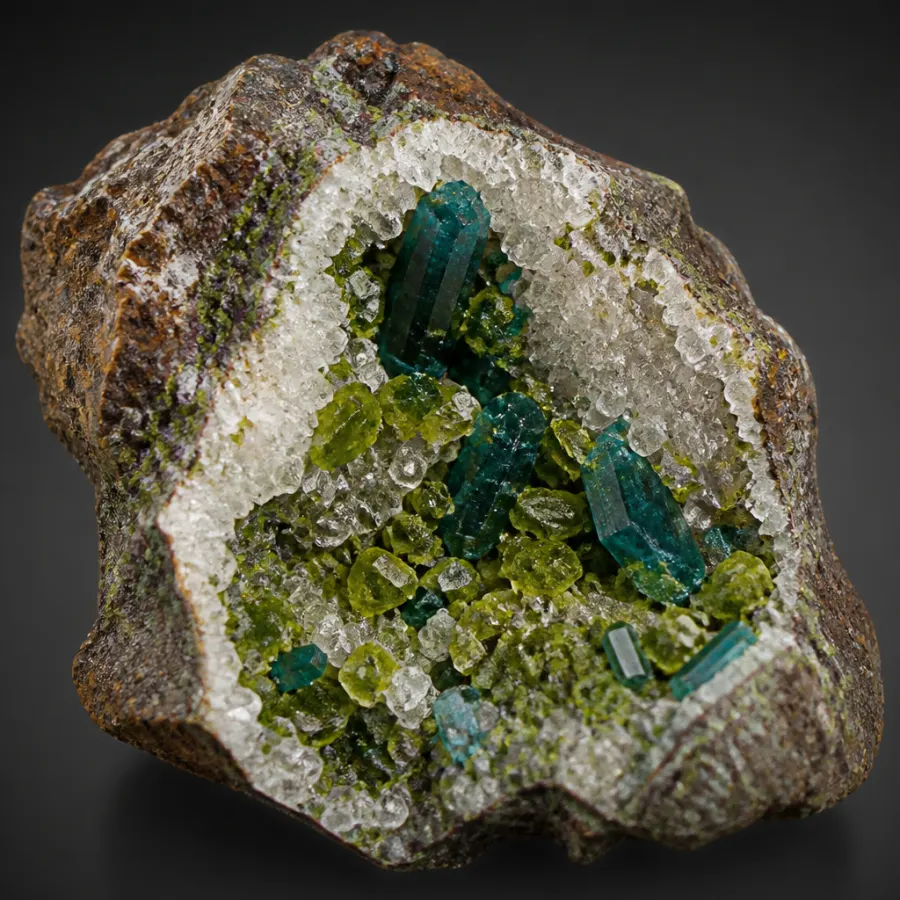
Cornwall was mined for copper and tin for roughly 200 years, and its oxidised copper zones produced a secondary suite found almost nowhere else: liroconite, clinoclase, olivenite, connellite and cornubite. Wheal Gorland carries most weight. Little is collected now — South Crofty, the last working tin mine, closed in 1998.
In short
- Cornwall is the defining British locality — worked for tin and copper on an industrial scale for roughly two centuries.
- The copper secondary suite is what collectors chase: liroconite, clinoclase, olivenite, connellite, cornubite, chalcophyllite.
- Wheal Gorland is the name that carries the most weight, particularly for liroconite.
- Cassiterite and native copper anchor the primary side.
- The Cornwall and West Devon Mining Landscape has been a UNESCO World Heritage Site since 2006.
| Species | Note | Why it matters |
|---|---|---|
| Liroconite | Wheal Gorland above all | The single most sought-after Cornish species |
| Clinoclase | Deep blue-green, Wheal Gorland and others | Rare and unmistakable |
| Olivenite | Widespread across the copper mines | The commonest of the fine copper arsenates |
| Connellite | Acicular blue sprays | Delicate; condition is everything |
| Cornubite / Cornwallite | Named for Cornwall itself | Type-locality material |
| Cassiterite | The economic mineral | Twinned crystals are the prize |
| Native copper | Widespread | Classic in older cabinets |
| Bournonite | Herodsfoot | Cogwheel twins — internationally famous |
Why Cornwall matters more than its size suggests
Cornwall's mineralogical importance is a direct consequence of how hard it was mined. Copper and tin were worked here on a scale and over a duration that opened an enormous volume of ground, and the oxidised zones of those copper lodes produced a secondary suite that is genuinely rare elsewhere.
The consequence for collectors is that a great deal of the best Cornish material was collected in the eighteenth and nineteenth centuries and has been circulating between cabinets ever since. Very little is coming out of the ground now — South Crofty, the last working tin mine, closed in 1998.
Wheal Gorland, and why the label carries a premium
Among Cornish mines, Wheal Gorland in the Gwennap district is the name that most reliably lifts a price. It is the classic source for liroconite — a soft blue-green arsenate that occurs in genuinely few places worldwide and nowhere else in comparable quality.
Because the material is old, provenance matters more here than almost anywhere. A specimen with a documented history through known collections is a different proposition to one with a modern label asserting the locality.
Condition, and what two centuries does to a specimen
Old Cornish material has usually lived in a drawer for a long time, and it shows. Acicular species like connellite are fragile and rarely perfect. Copper arsenates can dull with handling and exposure.
Restoration is common on classic Cornish pieces and is not disqualifying if it is disclosed. What matters is that repair, reconstruction and consolidation are declared plainly rather than discovered under a lamp.
What to look for when buying
Ask for the specific mine, not just 'Cornwall'. The county is a region, not a locality, and a serious piece should carry a mine name and ideally a collection history.
Look for old labels and keep them with the specimen. On classic British material the label is part of the value, and separating a piece from its documented history permanently reduces what it is worth.