Cassiterite
The mineral that funded Cornwall. Tin dioxide at hardness 6 to 7 and a density near 7, and at its best forming the elbow twins that collectors chase after.
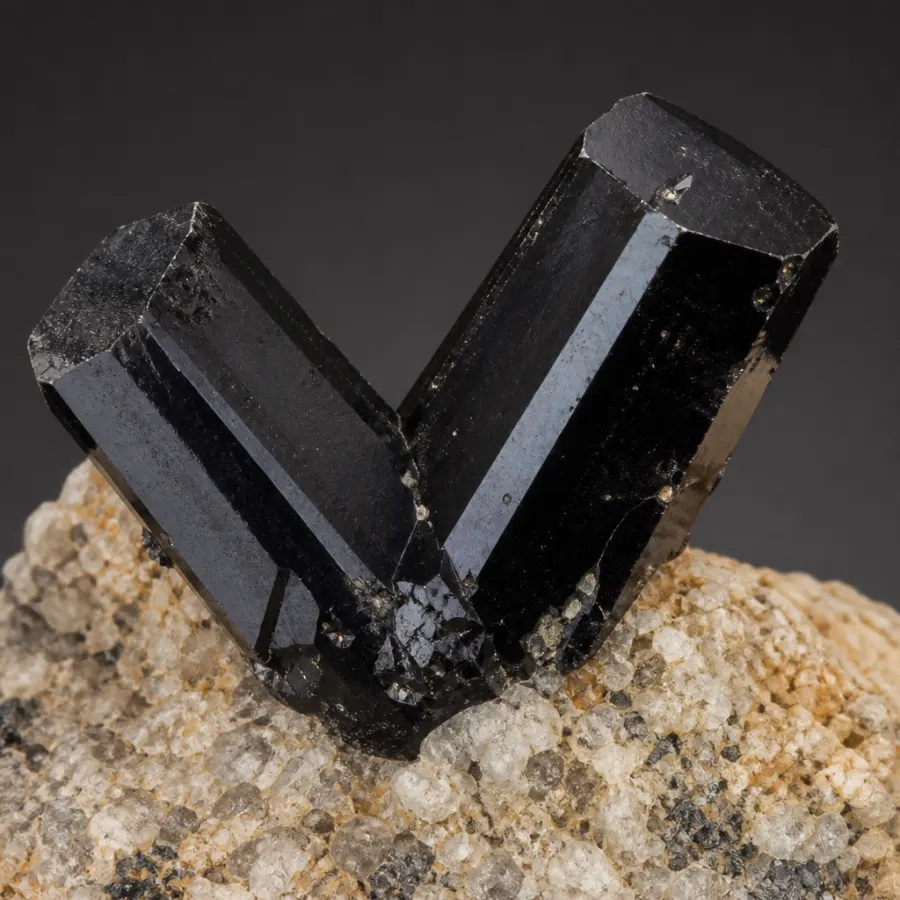
Cassiterite is tin dioxide, the ore that funded Cornwall. At a density near 7 it is conspicuously heavy for its appearance, which is the best quick field test. Hardness 6–7, black to red-brown with translucent edges. Elbow twins are the classic collectable habit and survive handling far better than copper arsenates.
In short
- Cassiterite is tin dioxide — the principal ore of tin and the reason Cornwall was mined.
- It is unusually heavy for a non-metallic-looking mineral, which is the easiest field test.
- Elbow twins are the classic collectable habit.
- Colour runs black to brown; thin edges often show red-brown translucency.
- Hard at 6–7, so unlike most Cornish secondaries it survives handling well.
| Property | What you see | Note |
|---|---|---|
| Density | Conspicuously heavy | The single best quick test |
| Hardness | 6–7 | Scratches glass |
| Colour | Black to red-brown | Edges often translucent red |
| Habit | Short prisms, elbow twins | Twins are the prize |
| Lustre | Adamantine to submetallic | Distinctive under a lamp |
The elbow twin
Cassiterite commonly twins on a plane that produces a sharp knee or elbow shape, sometimes repeated into more complex groupings. A well-formed elbow twin on matrix is the classic Cornish cassiterite specimen.
Because the species is hard and dense, these survive centuries of handling far better than the copper arsenates from the same mines, which is why good old cassiterite is more available than good old liroconite.
Weight as a test
At a density around 7, cassiterite is roughly two and a half times as heavy as quartz for the same volume. Pick up a piece and the weight is immediately wrong for its appearance.
That single property separates it from most of the dark minerals it might otherwise be confused with in the field.
Beyond Cornwall
Cornwall and Devon are the British sources, but cassiterite is worked worldwide and Bolivian and Chinese material is far more available. For a British suite, provenance to a named Cornish mine is what distinguishes a specimen from ore.