Devon
Devon shares Cornwall's geology and much of its mineralogy, with tungsten and scorodite at Hemerdon and a copper-arsenic story that is entirely its own.
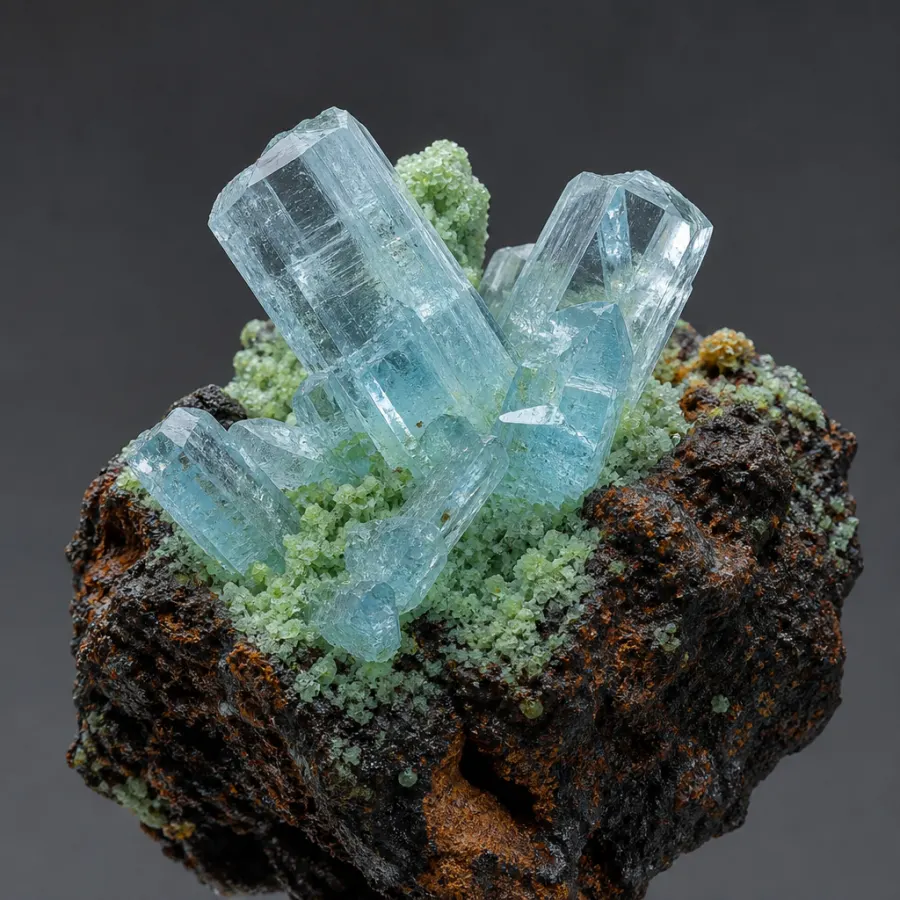
Devon shares Cornwall's granite-related mineralisation and much of its species list. Hemerdon Ball, near Plympton, is a tungsten-tin deposit whose 2006 dig produced gemmy blue scorodite — the find that made the locality known to collectors. Devon Great Consols was a major copper and arsenic producer through the 19th century.
In short
- Devon sits on the same granite-related mineralisation as Cornwall and shares much of its species list.
- Hemerdon Ball, near Plympton, is a tungsten-tin deposit and the source of the gemmy blue scorodite that made the locality famous among collectors.
- Devon Great Consols was among the great copper and arsenic mines of the nineteenth century.
- Devon material is generally scarcer on the market than Cornish equivalents.
- The county is part of the same UNESCO World Heritage mining landscape as Cornwall.
| Locality | Known for | Note |
|---|---|---|
| Hemerdon Ball / Drakelands | Scorodite, wolframite, cassiterite | Gemmy blue scorodite is the celebrated material |
| Devon Great Consols | Copper and arsenic species | Major nineteenth-century producer |
| Meldon | Contact-metamorphic suite | Quarry material, well documented |
| Wheal Betsy and Tamar valley mines | Lead and silver species | Less collected, genuinely scarce |
The Hemerdon scorodite
Scorodite — a hydrated iron arsenate — is common enough as a dull crust and rare as a gemmy crystal. The 2006 dig at Hemerdon Ball produced the latter: blue, transparent, and good enough to be written up in the mineralogical press at the time.
That single occurrence is disproportionately responsible for Hemerdon's standing among collectors. Material from it is finite and was largely distributed at the time.
Devon in Cornwall's shadow
Devon shares the same underlying geology and a great deal of the same species list, but has always been the less collected of the two counties. That has a practical consequence: comparable Devon material is often scarcer than the Cornish equivalent while attracting less attention.
For a collector building a British suite rather than chasing names, that gap is worth knowing about.
Arsenic, and handling old mine material
Devon Great Consols was an arsenic producer as well as a copper one, and arsenate and arsenide species are common across both counties. Scorodite, olivenite, clinoclase and their relatives are arsenic-bearing minerals.
They are entirely safe in a cabinet. Ordinary sense applies: do not grind, saw or dust them, wash your hands after handling, and keep them out of reach of children who might put things in their mouths.