Scorodite
Common as a dull crust, rare as a transparent blue crystal. The 2006 Hemerdon dig produced the latter, and it is what put that locality on collectors' maps.
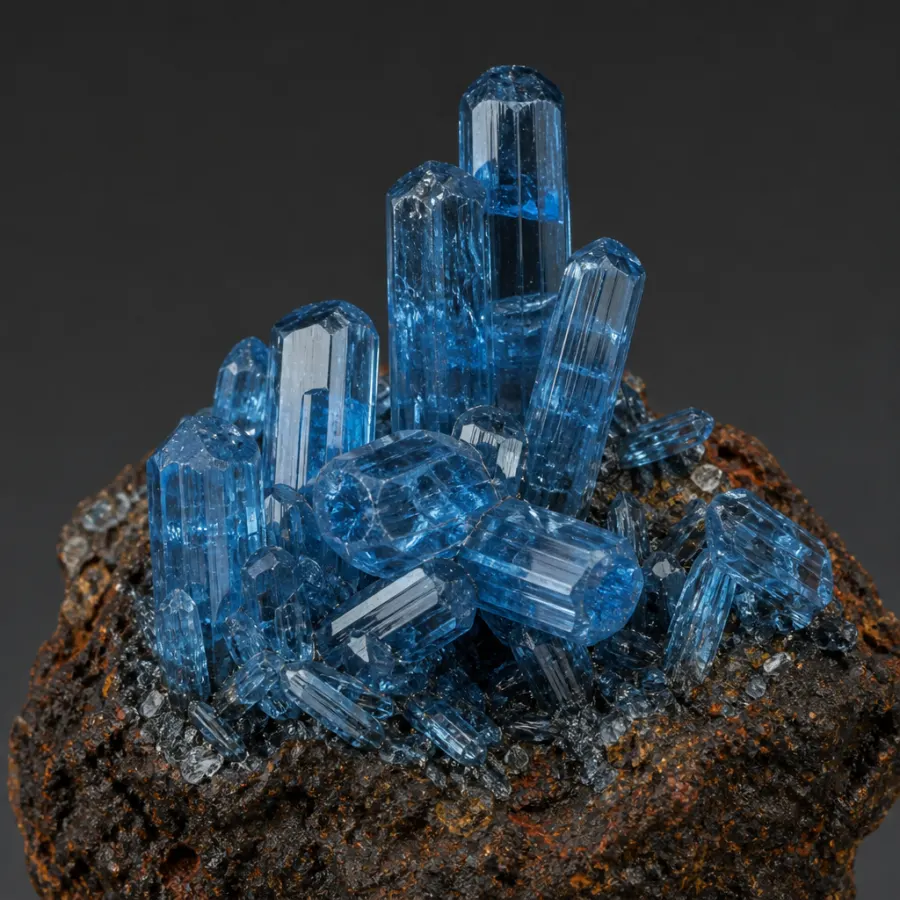
Scorodite is a hydrated iron arsenate, hardness 3½–4, that forms wherever arsenopyrite oxidises. It is common as a dull earthy crust and genuinely rare as a transparent crystal. The 2006 Hemerdon Ball dig in Devon produced gemmy blue crystals. Being a hydrate, it can dehydrate — keep it from heat and direct sun.
In short
- Scorodite is a hydrated iron arsenate, an oxidation product of arsenopyrite and related minerals.
- It is common as a dull earthy crust and genuinely rare as a gemmy crystal.
- The 2006 Hemerdon Ball dig in Devon produced transparent blue crystals good enough to be written up at the time.
- It is soft (3½–4) and can dehydrate — keep it out of heat and direct sun.
- An arsenic mineral: safe in a cabinet, but do not grind or dust it.
| Form | How common | Collector interest |
|---|---|---|
| Earthy crust or coating | Very common | Minimal |
| Botryoidal green-brown | Common | Modest |
| Small transparent crystals | Uncommon | High |
| Gemmy blue crystals | Rare | The material people want |
Why the gemmy material is scarce
Scorodite forms readily wherever arsenopyrite weathers, which is why crusts of it turn up on mine dumps across the world. What is rare is the combination of conditions that grows transparent, well-formed crystals rather than an amorphous coating.
That combination is local and short-lived, so gemmy scorodite tends to come from specific finds rather than from a locality continuously. Hemerdon is the British example.
Stability — the thing that catches people
Scorodite is a hydrate, and hydrates can lose water. Prolonged heat or direct sunlight can dull or degrade a transparent crystal permanently.
Store it away from windows and heat sources, and do not display it under a hot lamp. This is one of the few British species where storage conditions genuinely affect the specimen rather than just its surroundings.
Arsenic, in proportion
Scorodite is an arsenate. It is safe to keep and safe to handle. Do not grind, saw or dust it, wash your hands after handling, and keep it out of reach of small children — the same practice that applies to olivenite, clinoclase and the rest of the Cornish arsenate suite.