Bou Azzer
A cobalt district in the Moroccan Anti-Atlas, and the locality that every erythrite specimen in the world is judged against, with roselite alongside it.
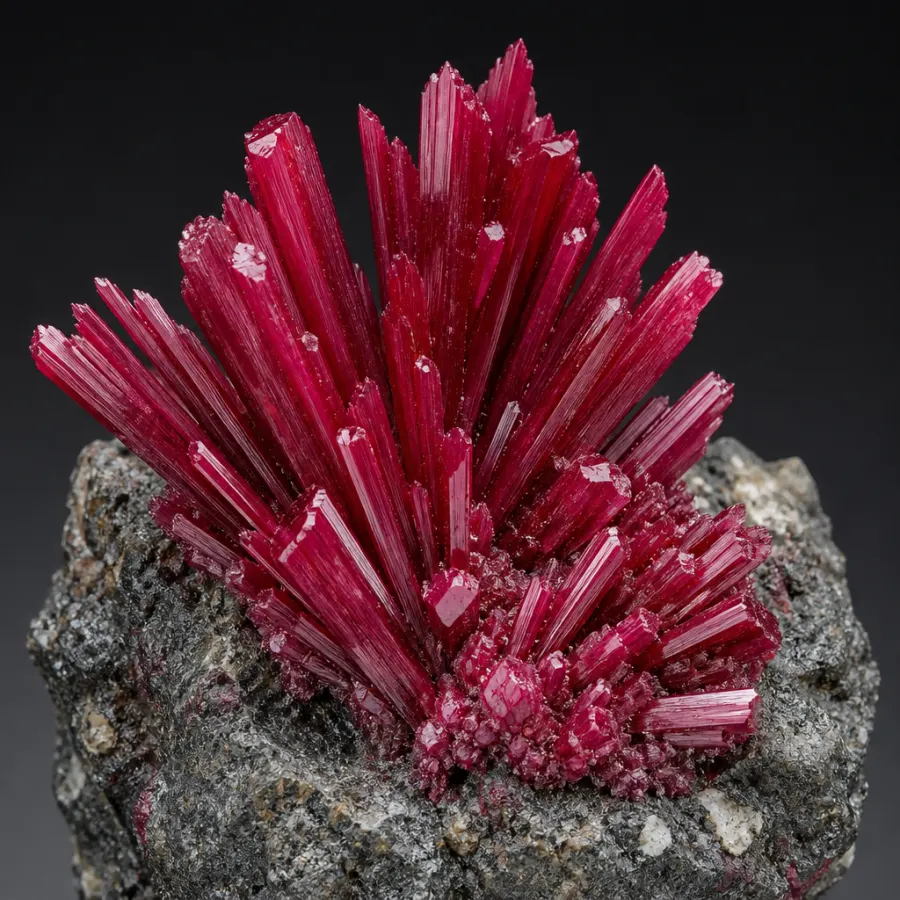
Bou Azzer, in Morocco's Anti-Atlas, is the world benchmark locality for erythrite — crimson cobalt arsenate, hardness 1.5 to 2.5. Bou Azzer has been mined for cobalt since the 1920s, one of very few deposits worldwide where cobalt is the primary metal rather than a by-product. Bou Azzer roselite, skutterudite and native silver come from the same serpentinite-hosted arsenide veins.
In short
- Bou Azzer is the reference locality for erythrite, Co3(AsO4)2·8H2O — crimson to magenta blades and sprays, hardness 1.5–2.5.
- Roselite (hardness 3.5) and its magnesium analogue wendwilsonite, described from Bou Azzer in 1987, are the other names collectors buy the district for.
- The ore is serpentinite-hosted cobalt–nickel arsenides: skutterudite, safflorite, löllingite and nickeline, with native silver.
- Cobalt has been worked here since the 1920s and mining continues, so this is one of the few classic localities still producing.
- At hardness 1.5–2.5 erythrite is damaged by almost any contact — condition, not size, is what you are paying for.
| Species | What it looks like | Why it matters |
|---|---|---|
| Erythrite | Crimson to magenta blades and radiating sprays, hardness 1.5–2.5 | The world standard for the species |
| Roselite | Rose-red to pink rhombs, often on quartz, hardness 3.5 | Bou Azzer is the classic source |
| Wendwilsonite | Visually near-identical to roselite | Type locality — described 1987 |
| Skutterudite | Silvery metallic cobalt arsenide, hardness 5.5–6 | The primary ore mineral |
| Talmessite | Pale green to colourless crusts and rosettes | The commonest associated arsenate |
| Native silver | Wires and arborescent growths | A by-product of the arsenide veins |
| Quartz | Colourless prisms | Usually the matrix carrying the erythrite |
Why a cobalt mine produced these minerals
Bou Azzer sits in a belt of serpentinised ultramafic rock in the Anti-Atlas, cut by veins carrying cobalt and nickel arsenides — skutterudite, safflorite, löllingite, nickeline — alongside native silver and gold. That primary assemblage is unusual in itself. Very few deposits anywhere are mined for cobalt as the principal metal; almost all the world's cobalt is a by-product of copper or nickel production.
The specimens follow from the arsenic. Where those arsenide veins met circulating water near surface they oxidised, and cobalt plus arsenate gives erythrite. The same chemistry with calcium in the system gives roselite and talmessite. A collector looking at a spray of crimson blades on quartz is looking at the weathered top of a cobalt orebody, which is why the colour is so consistent across the district.
Erythrite, and why condition is the whole question
Erythrite is soft — hardness 1.5 to 2.5, softer than a fingernail — and it grows as thin blades and fragile radiating sprays. Almost anything touching a spray will crush it. The practical result is that undamaged Bou Azzer erythrite is scarce out of all proportion to how much has been mined, and that a small perfect spray is a better specimen than a large scuffed plate.
Things to look at, in order: whether the blade tips are intact under a lens, whether the sprays stand proud of the matrix or have been flattened, colour saturation, and whether the piece has been consolidated with a lacquer or adhesive. Soft arsenates are among the most commonly stabilised species in the trade, and that should be disclosed.
Storage matters as much as buying. Keep erythrite in its own box, on a mount, and never let it travel loose against another specimen.
Roselite and wendwilsonite look the same
Roselite is a hydrated calcium cobalt arsenate, hardness 3.5, forming rose-red to deep pink crystals that are among the most attractive things the district produces. Wendwilsonite is its magnesium analogue, described from Bou Azzer in 1987 and named for the editor of the Mineralogical Record.
The two are not reliably separable by eye. Colour, habit and association overlap, and the distinction is compositional. A label that confidently says one rather than the other, with no analysis behind it, is a guess — and that is worth knowing before you pay a premium for the rarer name.
The mines within the district
"Bou Azzer" on a label is a district rather than a single working. Aghbar, Ait Ahmane, Bou Azzer East and Tamdrost are among the mines that have produced specimens, and the better dealers name the individual mine because the material differs between them.
Because mining is ongoing, new erythrite reaches the market regularly, and this is one of the few world-class classic localities where that is still true. It also means the market carries a wide quality range at once, from crusts sold cheaply in bulk to sprays that belong in a case.