Mibladen
A lead field in the Upper Moulouya of Morocco, and the locality that defines what vanadinite is supposed to look like: red-orange tablets sat on barite.
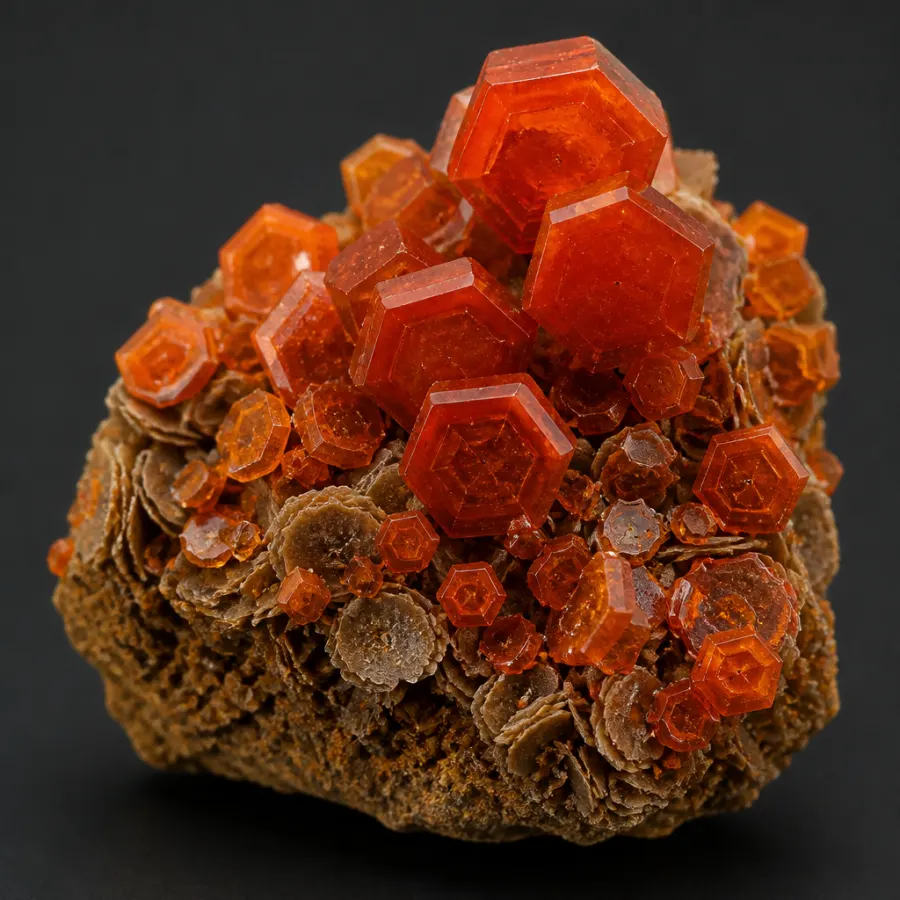
Mibladen, in the Upper Moulouya lead field about 5 km from Midelt in Morocco, is the world reference locality for vanadinite — lead chlorovanadate, hardness 2.5 to 3. Mibladen vanadinite is a brilliant red-orange, hexagonal and tabular, usually 3 to 10 mm across, sitting on white barite or brown goethite. Mibladen also yields cerussite, wulfenite, calcite and galena.
In short
- Mibladen is the benchmark locality for vanadinite, Pb5(VO4)3Cl, hardness 2.5–3 — red-orange hexagonal tablets.
- Crystals are typically 3–10 mm; anything well over 1 cm and undamaged is exceptional.
- The classic combinations are vanadinite on white barite and vanadinite on brown goethite — matrix is half the specimen.
- The district is a lead field first: galena, cerussite, wulfenite and calcite all come from the same workings.
- Colour is the value. Abraded or dulled crystals lose most of their appeal, and at hardness 2.5–3 they abrade easily.
| Species | What it looks like | Why it matters |
|---|---|---|
| Vanadinite | Red-orange hexagonal tablets and prisms, hardness 2.5–3 | The world standard for the species |
| Barite | White to cream tabular crystals | The classic matrix under the vanadinite |
| Goethite | Brown botryoidal crusts | The other classic matrix; strong colour contrast |
| Cerussite | Colourless to white, adamantine lustre | Common lead secondary |
| Wulfenite | Thin orange-yellow tablets | Present, but not why anyone buys Mibladen |
| Calcite | White to cream crystals | Often overgrows the vanadinite — a condition issue |
| Galena | Grey cubic ore | The primary lead source for all the secondaries |
Why the vanadinite here is this good
Vanadinite forms in the oxidised zone of lead deposits where vanadium is available in the groundwater. Both halves of that are needed, and both happen at Mibladen: an extensive lead orebody in the Upper Moulouya, and a dry, slowly weathering environment that let large, well-formed crystals grow instead of crusts.
The result is the mental image most collectors have of the species. Where a vanadinite from a less generous locality is a dull red-brown crust, Mibladen produces sharp hexagonal tablets with a resinous to adamantine lustre and a colour that runs from bright orange to deep blood red. For most collections, one Mibladen piece is the vanadinite.
Matrix is half the specimen
The two combinations that define the locality are vanadinite on white barite and vanadinite on brown goethite. Both are contrast plays: the crystals read far more strongly against a pale barite plate or a dark botryoidal crust than they do on rock.
That also makes matrix the commonest place for a specimen to have been improved. Look for crystals that sit at odd angles to the surface, glue lines under a lens, and vanadinite that appears on a matrix it does not naturally grow on. Assembled and repaired pieces circulate widely from this district, and while repair itself is normal and acceptable, non-disclosure is not.
Condition, and what to check first
At hardness 2.5 to 3, vanadinite is softer than a copper coin. Crystal edges chip, faces abrade to a dull finish, and once the lustre has gone from a face it cannot be brought back. Check the front-facing crystals under magnification before anything else, then look for calcite overgrowth, which can obscure the best crystals on an otherwise fine plate.
Contact damage where the specimen was removed from the pocket is normal and usually forgivable on the reverse. Damage to a display face is not.
Mibladen and the wider Moulouya field
Mibladen is one centre of a larger lead district that also includes the Aouli workings and Zeïda, a few kilometres away near Midelt. Labels are not always precise about which, and material from across the field is routinely sold simply as Moroccan.
Working is now largely artisanal, on and around the old lead mines, so specimens continue to appear. As with any actively collected locality, that means quality spans everything from bulk crusts to case pieces, and the difference between the two is crystal size, colour and condition rather than the locality name.