Panasqueira
Panasqueira, central Portugal: a tungsten mine on flat quartz-wolframite veins, licensed 1896, named on 3 of 176 Handbook sheets; panasqueiraite type locality.
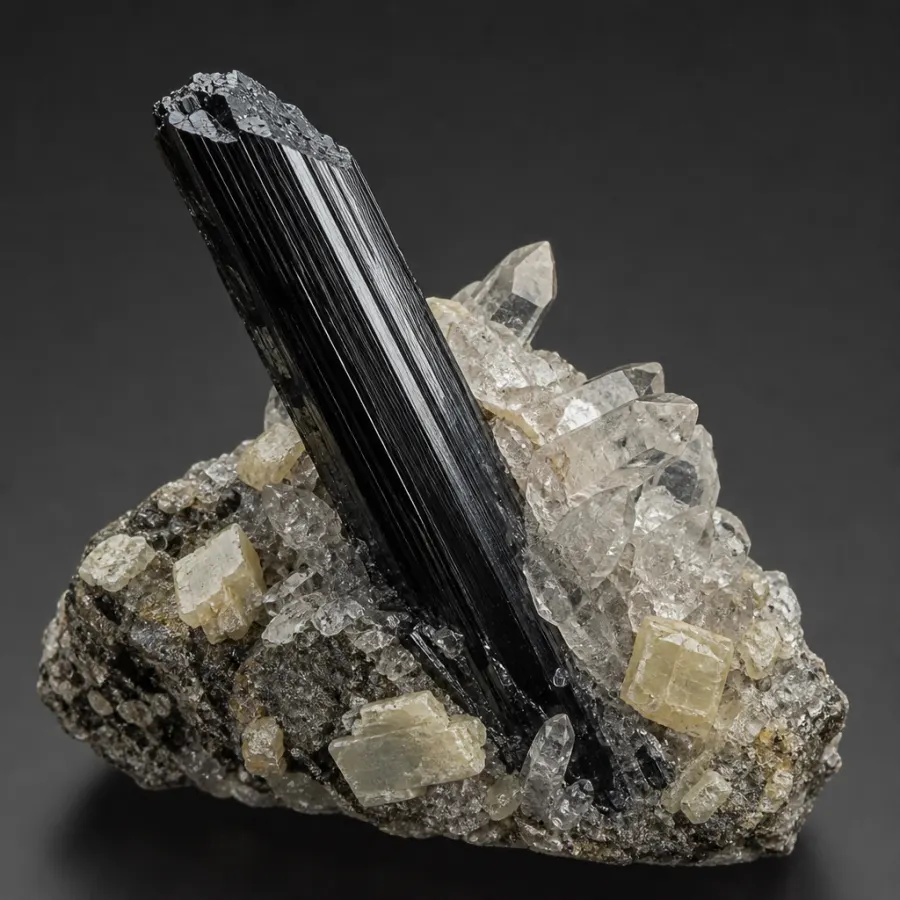
Panasqueira, in Covilhã, central Portugal, is a tungsten mine on flat quartz–wolframite veins; its mining licence is dated 24 May 1896. Panasqueira appears in the Distribution field of 3 of this site's 176 Handbook sheets: arsenopyrite, cassiterite and siderite. Panasqueira is also the type locality of panasqueiraite, a pink phosphate of hardness 5.
In short
- What the mine works. Breiter and co-authors (2023) describe quartz–muscovite veins rich in coarse-grained wolframite, tens of centimetres thick. The veins form a generally flat zone in Beira Group schists above a buried granite pluton of roughly 10 × 5 km. The deposit lies 200 km NE of Lisbon and 20 km W of Fundão.
- 3 of 176. Of the 176 Handbook of Mineralogy sheets in this site’s reference set, three name Panasqueira in their Distribution field: cassiterite (“At Panasqueira and Cabreiros, Portugal”), arsenopyrite and siderite. The ferberite and fluorapatite sheets, which are not in the set, also name it.
- Wolframite is not a species name. The September 2026 IMA-CNMNC Master List has no row for wolframite. The Handbook ferberite sheet says ferberite forms a series with hübnerite and lists Panasqueira. The hübnerite sheet does not. Ferberite, FeWO4, is H 4–4.5 and D 7.58, and 60.54% tungsten by mass (worked).
- The apatite is fluorapatite. All 70 microprobe analyses of typical apatite in Breiter et al. (2023), from all the rock types studied, correspond to fluorapatite, mostly 0.9–1 F apfu, with MnO commonly 0 to 4 wt%. The Handbook fluorapatite sheet names Panasqueira among a few of the many localities for fine crystals.
- Two phosphates with Panasqueira as their only listed place. Panasqueiraite (pink, H 5, D 3.22) is named for its type locality. The thadeuite sheet (yellow-orange, H <4, D 3.25) lists Panasqueira as its only Distribution entry. The IMA list gives Portugal as the country for both, and writes thadeuite as CaMg3(PO4)2(OH,F)2.
| Species | Formula (Handbook) | Hardness | Density | Colour (sheet) | Source placing it at Panasqueira | In the 176? |
|---|---|---|---|---|---|---|
| Ferberite (wolframite series) | Fe2+WO4 | 4–4.5 | 7.58 | Black | Ferberite sheet; Breiter et al. 2023 (as wolframite) | No |
| Cassiterite | SnO2 | 6–7 | 6.98–7.01 | Black, brownish black, reddish brown, red, yellow, grey, white | Cassiterite sheet | Yes |
| Arsenopyrite | FeAsS | 5.5–6 | 6.07 | Silver-white to steel-grey | Arsenopyrite sheet; Breiter et al. 2023 (in greisen) | Yes |
| Siderite | Fe2+CO3 | 3.75–4.25 | 3.96 | Yellowish brown, brown; white, ash-grey, pale green | Siderite sheet | Yes |
| Fluorapatite | Ca5(PO4)3F | 5 | 3.1–3.25 | Sea-green, violet, purple, blue, pink, yellow, brown, white, colourless | Fluorapatite sheet; Breiter et al. 2023 (70 analyses) | No |
| Panasqueiraite | CaMg(PO4)(OH,F) | 5 | 3.22 | Pink | Panasqueiraite sheet: type locality | No |
| Thadeuite | (Ca,Mn2+)(Mg,Fe2+,Mn2+)3(PO4)2(OH,F)2 | <4 | 3.25 | Yellow-orange | Thadeuite sheet: only Distribution entry | No |
Where Panasqueira is, and what the veins look like
Location. Breiter and co-authors (Minerals 13, 163, 2023) place the deposit in central Portugal, 200 km NE of Lisbon and 20 km W of Fundão. The operator’s history page gives the mine as in Covilhã, village of Panasqueira. The ore treatment plant is now at Barroca Grande, where milling was consolidated in 1998, according to the same page.
Geology. The host rocks are Beira Group schists of Ediacaran to Cambrian age in the Central Iberian Zone. They were metamorphosed and deformed between 359 and 306 Ma and intruded by granites dated 320 to 290 Ma. A buried granite under the mine was first hit by a mining gallery in 1950. The ore is quartz–muscovite veins rich in coarse-grained wolframite, tens of centimetres thick. They form a generally flat zone in the schists above the granite–schist contact. In the greisenised leucogranite of the cupola, sulfides (pyrite, arsenopyrite) are common and cassiterite is accessory.
Inside a vein. The same paper describes the wolframite-bearing quartz veins as flat-lying and under 1 m thick. They are usually rimmed by coarse-grained muscovite several centimetres thick, grown perpendicular to the vein wall. The inner parts are milky quartz rich in wolframite, in columns up to 20 cm, with fewer sulfides. Apatite and carbonates are subordinate, and tourmaline and rutile appear along the contact with the schists. The rest of the localities are on the localities index.
Which minerals the Handbook places at Panasqueira
The count is 3 of 176. Method: a script reads the Distribution field (from Distribution: to the next Name:) of each of the 176 sheets in this site’s reference set as pdftotext -layout text, strips diacritics, expands ligatures, joins line breaks and matches case-insensitively. The pattern Panasqueira matches three sheets: arsenopyrite (“From Panasqueira, Portugal”), cassiterite (“At Panasqueira and Cabreiros, Portugal”) and siderite (“At Panasqueira, Portugal”). As a check, the cassiterite match was read by eye in the raw text. No sheet names Panasqueira outside its Distribution field.
Outside the set. The ferberite, fluorapatite, panasqueiraite and thadeuite sheets were fetched this run as comparators. All four name Panasqueira; they are not counted in the 176. The hübnerite sheet was fetched as well and does not name it. That is the reason this page says ferberite where a label would say wolframite: the sheet evidence points to the iron end of the series. A specimen’s actual Fe/Mn needs an analysis.
What the count does not mean. The Handbook Distribution field lists selected localities. Three sheets is a floor, not a species list for the mine. Quartz and muscovite, for instance, make up the veins, but neither sheet names Panasqueira. See what is a type locality for how panasqueiraite’s status differs from a Distribution mention. For handling arsenopyrite, see is arsenopyrite dangerous; this page gives no safety advice.
Ferberite, cassiterite and arsenopyrite: telling the heavy ones apart
All three are dark, heavy and from the same veins. The sheets separate them better on hardness and lustre than on weight:
- Ferberite: H 4–4.5, D 7.58, black, submetallic to metallic adamantine, cleavage {010} perfect. Brownish black to black streak. The sheet records it as slightly magnetic.
- Cassiterite: H 6–7, D 6.98–7.01. Scratches glass where ferberite does not.
- Arsenopyrite: H 5.5–6, D 6.07, silver-white to steel-grey metallic.
Worked composition. On standard atomic weights FeWO4 is 76.34% WO3, which matches the sheet’s ideal column exactly, and 60.54% W by mass. Cassiterite, SnO2, is 78.77% Sn. A 1912 figure on the operator’s history page gives 267 tons of concentrate at 65% WO3. That is 173.6 t of WO3, or 137.6 t of contained tungsten.
Density as a test: 7.58 against 6.98–7.01 is a gap of about 8%, which a kitchen balance can see only on a clean single crystal; see how to measure specific gravity at home. Fluorapatite (3.1–3.25) and siderite (3.96) are in another class. The species index has the full species pages, including apatite.
1881, 1896 or 1898: when did Panasqueira start?
The sources give three dates, and they measure different things. The operator’s history says the discovery registration was granted on 15 September 1881. It says the official mining licence is dated 24 May 1896, the year the company was founded to mine tungsten at Panasqueira. Breiter and co-authors refer to the deposit’s opening in 1898. We print all three and do not pick one.
Later dates from the same two sources. Breiter et al. say the mine was temporarily closed in 2003 and then reopened. The operator’s page records copper recovery from plant tailings introduced in the 1950s, and Level 2 ore extraction from 1982. It names Almonty’s subsidiary Beralt Tin and Wolfram (Portugal) SA as the owner. We do not state whether anyone may collect there.
On a label. Panasqueira, Covilhã, Portugal is what the sources support; a level or a named working such as Barroca Grande adds provenance; see how to label and catalogue a mineral collection. Nothing here is offered for sale; the wanted list is the only commercial route.