Smithsonite
A zinc carbonate that comes in almost every colour, usually as botryoidal crusts with a silky lustre unlike anything else. Hardness 4 to 4.5, and ZnCO3.
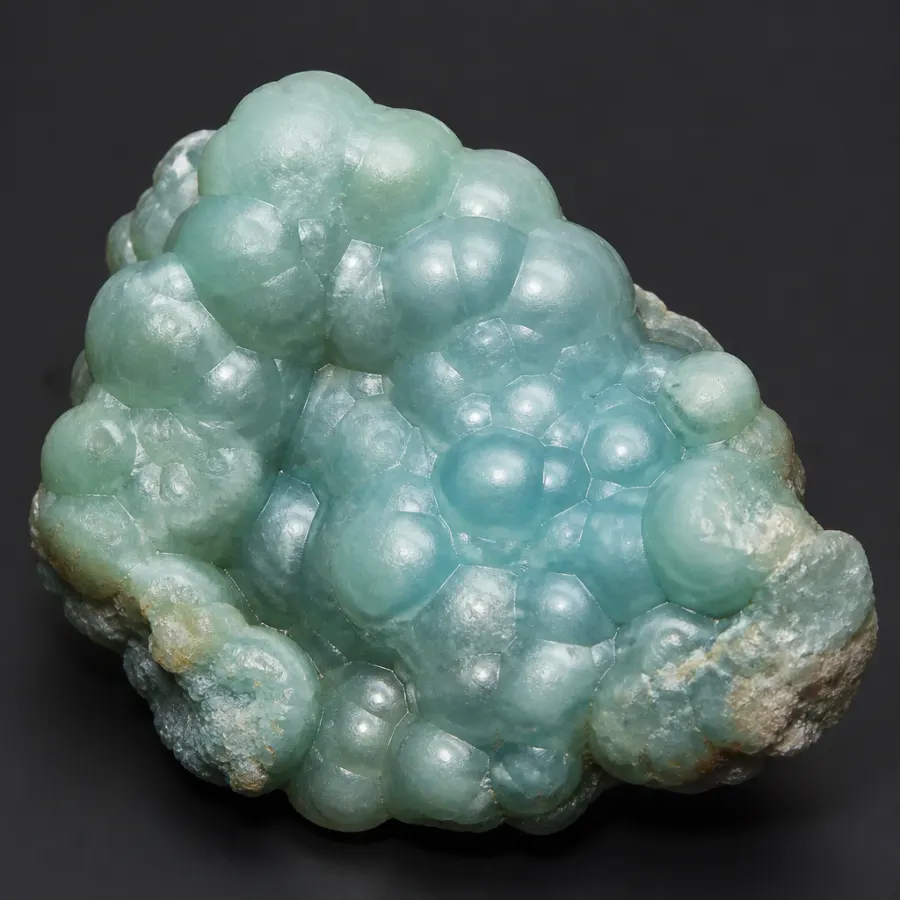
Smithsonite is a zinc carbonate, hardness 4–4½, usually forming botryoidal crusts with a distinctive silky to pearly lustre. Colour ranges from blue-green through yellow, pink and lavender depending on trace elements. Tsumeb, Kelly Mine in New Mexico, Broken Hill and Choix in Mexico produced the finest, and good crystallised smithsonite is genuinely rare.
In short
- A zinc carbonate, hardness 4–4½, usually botryoidal rather than crystallised.
- Colour spans blue-green, yellow, pink and lavender — trace elements decide it.
- The silky lustre is diagnostic and does not photograph well.
- Best from Tsumeb, the Kelly Mine in New Mexico, Broken Hill and Choix.
- Sharp crystallised smithsonite is much rarer than botryoidal and priced accordingly.
| Colour | Cause | Classic source |
|---|---|---|
| Blue-green | Copper | Kelly Mine, New Mexico |
| Yellow | Cadmium | Tsumeb, Namibia |
| Pink to lavender | Cobalt | Choix, Mexico |
| Green | Copper | Broken Hill, Australia |
| Colourless to white | — | Widespread |
The lustre is the tell
Smithsonite has a silky, almost waxy sheen that is unlike the glassy lustre of most carbonates. In hand it reads as slightly soft-focus; in photographs it usually looks flat, which is why smithsonite consistently under-sells online and rewards buying in person.
Combined with the botryoidal habit and a hardness around 4, it is hard to confuse with anything else once you have handled a good piece.
Colour is chemistry
The colour range comes from trace substitution: copper for blue-green, cadmium for yellow, cobalt for pink. That is why particular localities are associated with particular colours rather than producing the full range.
Kelly Mine blue-green is the one most collectors picture, and good Kelly material has been scarce for decades.
Care
At hardness 4–4½ it scratches against harder specimens in a shared drawer, and the botryoidal surface shows marks readily. Individual boxes.
It is a carbonate, so keep it away from anything acidic — including some cleaning products and long-term contact with untreated wood or card that can off-gas.