Wulfenite
PbMoO4, thin orange tablets out of the oxidised zone of lead mines, and the two Arizona localities that the whole of the species is measured against now.
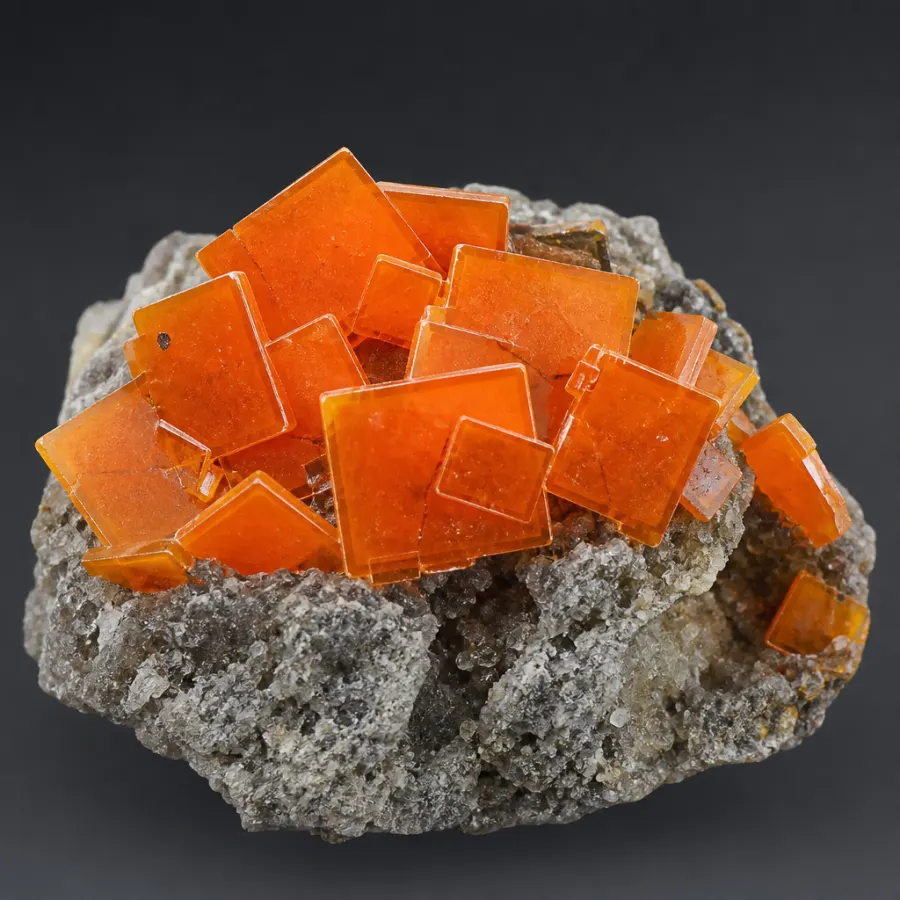
Wulfenite is lead molybdate, PbMoO4, hardness 3, tetragonal, forming thin square tablets to blocky crystals in the oxidised zone of lead ore bodies. Haidinger named it in 1845 for Bad Bleiberg in Carinthia, Austria. The Red Cloud mine in Arizona and Los Lamentos in Mexico, where crystals exceed 6 cm, are the benchmarks.
In short
- Wulfenite is PbMoO4, tetragonal, hardness 3, specific gravity about 6.5–7.0 — thin square tablets through to blocky pyramidal crystals.
- Named by Haidinger in 1845 after Franz Xaver von Wulfen, who wrote the monograph on the Bleiberg lead ores.
- It is a secondary mineral of the oxidised zone: the lead comes from the orebody, the molybdenum from somewhere else in the system, which is why it is far scarcer than the lead ores it accompanies.
- The Red Cloud mine, Arizona and the Erupción/Ahumada mine at Los Lamentos, Chihuahua — crystals over 6 cm — are the two localities the species is judged by.
- Tungsten substitutes for molybdenum toward stolzite, PbWO4. The two are not separable by eye.
| Locality | Habit and colour | Note |
|---|---|---|
| Red Cloud mine, La Paz Co., Arizona | Thick tabular, deep orange-red, brilliant lustre | The species benchmark; collected since the 19th century |
| Erupción/Ahumada, Los Lamentos, Chihuahua | Thick tabular to blocky, butterscotch to orange, over 6 cm | The largest fine crystals known |
| Rowley mine, Maricopa Co., Arizona | Thin tabular orange, often with mimetite | Dug specifically for specimens |
| Tsumeb, Namibia | Tabular to blocky, orange to amber | Part of the great Tsumeb oxide suite |
| Ojuela, Mapimí, Durango | Small orange tablets in the arsenate suite | Alongside adamite and legrandite |
| Mežica (Mies), Slovenia | Thin yellow-orange tablets | The classic European source |
| Mibladen, Morocco | Yellow to orange tablets with vanadinite and barite | Usually a by-product of vanadinite digging |
What wulfenite is, and why it is not everywhere
Wulfenite is lead molybdate. It forms in the oxidised zone above a lead orebody, which supplies the lead, but the molybdenum has to be supplied separately — leached out of the surrounding rock, or out of molybdenite in the primary ore. Plenty of lead mines have an oxidised zone with cerussite, anglesite and pyromorphite in it and no wulfenite at all, because there was no molybdenum available.
Crystallography does most of the visual work. Wulfenite is tetragonal, and its commonest habit is a square or near-square tablet, sometimes so thin it is translucent at the edge, sometimes thickened to a blocky or steeply pyramidal crystal. The colour — yellow through orange to a deep blood red — comes from the molybdate itself and from trace chromium and vanadium.
Tungsten can substitute for molybdenum, running toward stolzite (PbWO4). Intermediate material exists, looks like wulfenite, and cannot be told apart from it without analysis.
Red Cloud, and why Arizona owns the species
The Red Cloud mine sits in the Silver District in the Trigo Mountains, La Paz County, Arizona, and it produces the wulfenite that every other wulfenite is compared against: thick tabular crystals in a deep orange-red, with a lustre that reads almost metallic in raking light, on a pale altered matrix. Ed Over dug there in the 1930s, and a specimen with an Over-era provenance is a different object in the market from a modern one of the same quality.
The mine has been in private hands and worked only sporadically for specimens, so supply arrives in bursts rather than steadily, and a good deal of what changes hands is material recirculating out of old collections. That is worth knowing when a dealer describes a piece as "recently out" — for Red Cloud, recently out of a collection and recently out of the ground are very different claims.
Arizona has other wulfenite localities worth the label. The Rowley mine in Maricopa County has been dug persistently for thin tabular orange crystals, often with mimetite, and the Glove and Old Yuma mines have produced good material historically.
Los Lamentos, and the Mexican material
The Erupción/Ahumada mine in the Los Lamentos Mountains of Chihuahua has produced the largest fine wulfenite crystals known — documented above 6 cm — in habits running from thin tabular through blocky and pseudocubic to steeply bipyramidal, generally in a butterscotch to orange yellow rather than Red Cloud's red.
The material has surfaced in distinct batches over the decades, each batch consistent in habit and colour, which points to individual pockets rather than a continuous production. It is one of the reasons Los Lamentos wulfenite can often be placed to a period by eye alone, and one of the reasons a knowledgeable dealer will tell you which batch a piece looks like it belongs to.
Ojuela at Mapimí in Durango also produces wulfenite, generally as small orange tablets alongside the arsenates the mine is better known for.
Condition: edges, plates and repairs
Wulfenite is hardness 3 and brittle, and its characteristic habit is the worst possible shape for survival. A thin square tablet standing off matrix has four exposed edges and two exposed corners, and chips at the corners are the single commonest defect on the market.
Check the edges of every significant crystal under a lens, not the faces. A chip shows as a bright fresh surface where the rest of the crystal has a slight surface sheen. Then check where the crystals meet the matrix: reattached tablets are common, and the giveaway is a hairline of adhesive, a gap under one edge, or a crystal orientated differently from every other crystal on the piece.
Because the species is so thin-bladed, disclosed repair is normal on important specimens and is not in itself a reason to walk away. Undisclosed repair is.
Light, and the precaution collectors take
Collectors routinely keep wulfenite out of direct sunlight. Whether the colour genuinely fades is argued over, and we have not seen a controlled demonstration either way — so treat it as an open question rather than a fact.
The precaution costs nothing. A display case away from a south-facing window, or a drawer, protects against the possibility at no expense in enjoyment. The certain risks are more prosaic: physical contact, dust that has to be brushed off a hardness-3 crystal, and the lead content, which means no sawing, sanding or dry brushing and washing your hands afterwards.