Dalnegorsk
Primorsky Krai, in the Russian Far East: skarn ore bodies producing datolite, ilvaite, calcite, fluorite and galena at a level no other skarn matches.
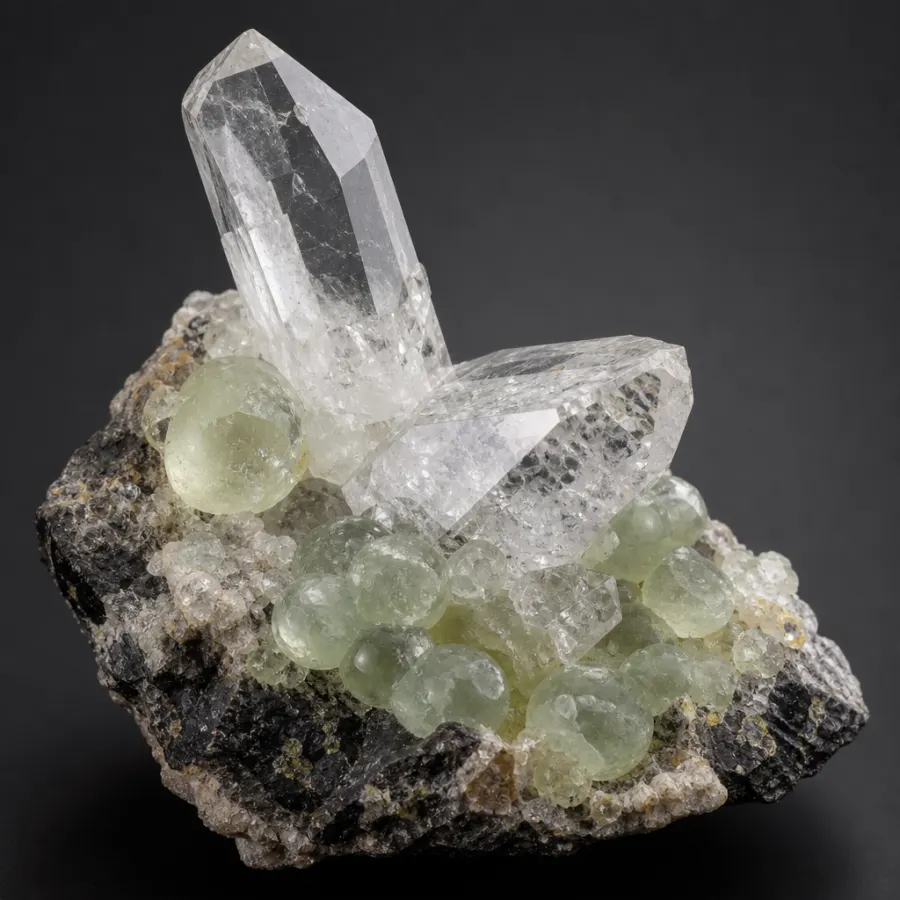
Dalnegorsk in Primorsky Krai is Russia's most important specimen locality. Mining at Dalnegorsk started in 1897, when the settlement was still called Tetyukhe; it was renamed in 1972. Dalnegorsk skarn ore bodies yield datolite, ilvaite and hedenbergite alongside the calcite, fluorite, galena and quartz the district is best known for.
In short
- Dalnegorsk is in Primorsky Krai, the Russian Far East. Mining began in 1897 under the name Tetyukhe; the town was renamed in 1972 and given city status in 1989.
- Two deposits, two suites: a borosilicate skarn (datolite, danburite, axinite, ilvaite, hedenbergite) and a polymetallic skarn (galena, sphalerite, fluorite, calcite, quartz).
- The Nikolaevskiy mine, opened in 1982, is the source of most of the crystallised sulphides and the fluorite in circulation.
- Dalnegorsk is the world's best locality for ilvaite, hardness 5.5–6 — better than Elba, which gave the species its name — and for large gemmy datolite.
- Old labels read Tetyukhe; later ones read Dal'negorsk or Dalnegorsk. Same district throughout.
| Species | What Dalnegorsk produces | Hardness |
|---|---|---|
| Datolite | CaBSiO4(OH); colourless to pale green glassy wedge-shaped crystals, sometimes very large | 5–5.5 |
| Ilvaite | Black striated prisms, commonly on quartz — the world standard | 5.5–6 |
| Calcite | Colourless to honey scalenohedra, phantoms common | 3 |
| Fluorite | Colourless, green and purple cubes, often on quartz and sulphides | 4 |
| Galena | Sharp cubo-octahedra on quartz and calcite | 2.5 |
| Sphalerite | Lustrous dark brown to black crystals with chalcopyrite | 3.5–4 |
| Danburite | Colourless prisms with wedge terminations | 7 |
| Axinite-(Mn) | Brown wedge-shaped crystals | 6.5–7 |
| Hedenbergite | Dark green radiating sprays, often under the sulphides | 5.5–6 |
| Apophyllite | Colourless to green tabular crystals, late in the sequence | 4.5–5 |
Skarn, and why one district gives two suites
A skarn forms where a hot intrusion meets carbonate rock and rebuilds it chemically — the limestone is dissolved and replaced by calc-silicate minerals, and metals carried by the intruding fluids are dropped along the way. Dalnegorsk has this on a large scale, and it happened more than once with different fluid chemistry, which is why the district behaves like two localities under one name.
One system was boron-rich. It produced the borosilicate deposit worked in the Bor open pit, and with it datolite, danburite, axinite and the calc-silicates hedenbergite and ilvaite. The other was a polymetallic lead-zinc system, which gave the sulphide ore bodies and the galena, sphalerite, quartz, fluorite and calcite that most collectors think of first.
A collector reading a Dalnegorsk label is therefore reading a district, not a mine, and the mine name matters — a datolite and a galena from Dalnegorsk did not come from the same hole in the ground.
Datolite and the borosilicate deposit
Datolite is calcium borosilicate, CaBSiO4(OH), hardness 5 to 5.5, and it usually turns up worldwide as small glassy wedge-shaped crystals in basalt cavities. Dalnegorsk produces it on a different scale entirely: transparent to pale green crystals, sharply formed, with the complex wedge and prism faces that make the species interesting, in sizes that no basaltic occurrence approaches.
It comes out of the borosilicate skarn, where boron was abundant enough to make datolite a rock-forming mineral rather than a rarity. The Bor pit is also the type locality for dalnegorskite, described from the deposit.
Danburite, the other calcium borosilicate, occurs in the same system as colourless prisms at hardness 7. If you have a colourless prismatic crystal from Dalnegorsk and are unsure which you are holding, hardness separates them cleanly: datolite will not scratch quartz, danburite will.
Ilvaite: the world standard for the species
Ilvaite is a calcium iron silicate, hardness 5.5 to 6, and it is named after Ilva — the Roman name for Elba, its type locality. Elban ilvaite is historically important and mostly disappointing to look at.
Dalnegorsk redefined what the species could be: black, strongly striated prismatic crystals with sharp terminations, often standing off a bed of quartz or associated with hedenbergite and the sulphides, and at sizes and quality that make an opaque black mineral genuinely worth displaying. If you have seen a photograph of good ilvaite, you have almost certainly seen a Dalnegorsk specimen.
The practical checks are the terminations and the striated prism faces, which are where damage shows on a hard, brittle, prismatic species — and whether the crystals stand proud of the matrix or are embedded in it, which is most of the difference in quality.
The Nikolaevskiy sulphide suite
The Nikolaevskiy mine, opened in 1982, is a polymetallic skarn working and the source of most of what reaches the market with a Dalnegorsk label: fluorite in colourless, green and purple cubes; sharply formed galena cubo-octahedra; lustrous sphalerite; pyrrhotite, chalcopyrite and arsenopyrite; and calcite in colourless to honey-coloured scalenohedra, often with phantoms recording growth interruptions.
The combinations are what makes the material. Purple fluorite cubes on white quartz with galena, or a honey calcite scalenohedron perched on sulphides, are aesthetic in a way that single-species specimens are not, and the mine has produced enough of them over four decades to be a fixture of the market.
Apophyllite appears late in the sequence as colourless to green tablets on the sulphides — a low-temperature mineral closing out a high-temperature system.
Names, labels and supply
The settlement was founded in 1897 as Tetyukhe, after an expedition found rich lead-zinc ore in the river valley, and the merchant Jules Bryner founded the Tetyukhe mining company to work it. Bryner's grandson Yul Brynner became the actor. In 1972, in a general renaming of Chinese-derived place names across the Russian Far East, Tetyukhe became Dalnegorsk; it was granted city status in 1989.
For a collector this means three label forms are all correct for the same district: Tetyukhe on pre-1972 material, and Dal'negorsk or Dalnegorsk since — the apostrophe is a transliteration of the Russian soft sign and carries no other meaning. A Tetyukhe label is a genuine indicator of age, and worth keeping with the specimen.
Supply has always tracked mining activity rather than any specimen operation, and it has been intermittent. A good proportion of the Dalnegorsk material offered in Europe and North America now is older stock recirculating from collections rather than recent production, so buy the specimen in front of you and treat "new find" claims with the same scepticism you would apply anywhere.