Milpillas Mine
A working copper mine in Sonora. Milpillas azurite is the modern benchmark for the species, and the shallow oxidised zone that produced it was a thin one.
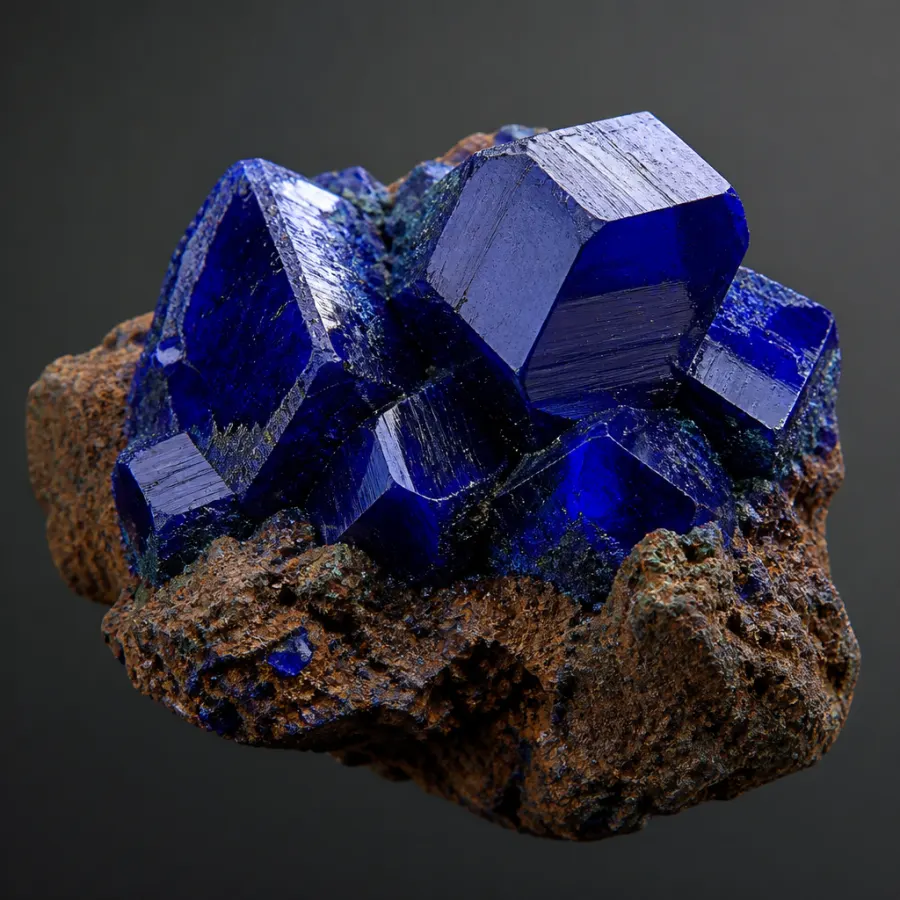
Milpillas is an underground copper mine in Santa Cruz Municipality, Sonora, Mexico, in the Cananea district, where production began in 2006. Milpillas azurite — deep blue, glassy, sharply terminated crystals — came from a shallow oxidised zone, most of which was worked out by late 2011. Milpillas is a producing copper operation, not a specimen mine.
In short
- Milpillas is an underground copper mine in the Cananea district of Sonora, Mexico. Production began in 2006, and the first azurite reached the market the same year.
- Its azurite — Cu3(CO3)2(OH)2, hardness 3.5–4 — is the finest of the modern era: intense blue, glassy, sharply terminated, often free-standing.
- The crystals came from a supergene oxidised zone sitting above the sulphide ore. Most of the principal oxide bodies were mined out by late 2011 and the operation moved onto the chalcocite ore beneath.
- Malachite pseudomorphs after azurite are a Milpillas speciality, including partial replacements that keep a blue core inside a green shell.
- Labels read Milpillas mine, Cuitaca or Santa Cruz Municipality, Sonora. Both refer to the same working.
| Species | Appearance | Note |
|---|---|---|
| Azurite | Deep blue blocky to tabular crystals, glassy lustre, commonly free-standing | What the mine is known for |
| Malachite after azurite | Green pseudomorphs holding the azurite crystal form | Complete and partial replacements |
| Malachite | Botryoidal crusts and velvety coatings | Common; less sought than the pseudomorphs |
| Cuprite | Dark red octahedra and crusts | Sometimes with native copper |
| Brochantite | Emerald-green acicular sprays | A copper sulphate of the oxidised zone |
| Chrysocolla | Blue-green crusts | Often coating other species |
| Chalcocite | Grey copper sulphide | The primary ore beneath the oxidised zone |
A copper mine, not a specimen mine
This distinction explains almost everything about Milpillas material. The mine exists to produce copper cathode, and the specimens were a by-product of driving development through an oxidised orebody on a production schedule. Nobody was working a pocket carefully for a week; the crystals that survived did so because someone on shift recognised them and stopped.
Two consequences follow. The first is that damage is common — Milpillas azurite has often been through a blasting round before anyone saw it, and repaired and reattached crystals are widespread in the market. The second is that supply was never controlled. When the oxidised bodies were exhausted, the supply stopped, and no amount of demand brought it back.
The geology, briefly
Milpillas sits in the Cananea district, one of the great porphyry copper provinces of North America. A disseminated primary copper sulphide system was exposed to weathering; copper was leached out of the upper part, carried down in solution, and redeposited lower as a concentrated blanket of oxide and secondary sulphide ore — chalcocite, cuprite, malachite, azurite, chrysocolla.
That process is called supergene enrichment, and it is why the ore was worth mining: the copper had been pre-concentrated by geology. It is also why the specimens exist. Carbonate in the system plus mobile copper gives azurite and malachite, and where those solutions found open space, they grew crystals rather than crusts.
The zone that produces specimens in a deposit like this is thin and finite by definition. That is the whole story of Milpillas supply.
What Milpillas azurite looks like
The hallmark is a combination that no other azurite locality quite matches: an intense, luminous blue that stays blue in a way older material often does not, a genuinely glassy lustre on the faces, and sharp complete terminations on blocky to tabular crystals that frequently stand free rather than lying in a crust.
Compare that with Tsumeb azurite, which is superb but characteristically darker and often nearly black in mass, and with Chessy-les-Mines in France — the locality behind the synonym "chessylite" — which produced classic but generally smaller and duller material. Milpillas is brighter than either. Crystals up to several centimetres exist; most good specimens are in the 1 to 3 cm range for the individual crystals.
Azurite is hardness 3.5 to 4 with good cleavage, so the practical points are the usual ones: check terminations and edges under a lens, look at contact points on the matrix, and hold the piece to a raking light to find repairs.
Malachite after azurite, and why it matters here
Azurite is metastable relative to malachite under many near-surface conditions, and where groundwater chemistry shifted, Milpillas azurite crystals were replaced by malachite while keeping their external form. The result is a pseudomorph: a crystal with azurite's sharp blocky shape and malachite's green colour and fibrous internal structure.
Milpillas produced these in quantity and in quality, and they are collected in their own right rather than as curiosities. The most interesting are the partials — a green replaced exterior with unaltered blue azurite still visible in the core, or a plate where some crystals converted and their neighbours did not. Those pieces record the reaction mid-way through, which is why they are worth more than either end state.
Label them properly. "Malachite pseudomorph after azurite" is the correct form; a piece described simply as malachite is undersold, and one described as azurite is mis-sold.
Supply, and what to check before you buy
Most of the principal copper oxide bodies were worked out by late 2011, and the operation converted to processing the chalcocite ore beneath. New Milpillas azurite has been scarce since, and the great majority of what is offered today is material recirculating out of collections and dealer stock built up between 2006 and about 2012.
That has a practical implication. Because good Milpillas azurite is in demand and no longer replaceable, the incentive to repair, reattach and improve pieces is high. Check where each crystal joins the matrix; check for a crystal that sits at an angle unrelated to its neighbours; check terminations under magnification for a bright, freshly broken surface against the natural lustre. Ask directly whether a piece has been repaired, and expect a straight answer — disclosed repair is normal on a specimen of this kind and is not a reason to walk away.