Calcite
Calcite is CaCO3: hardness 3, density 2.7102, perfect {10-11} cleavage, over 1000 crystal forms. 60 of the other 175 sheets in our set name it as an associate.
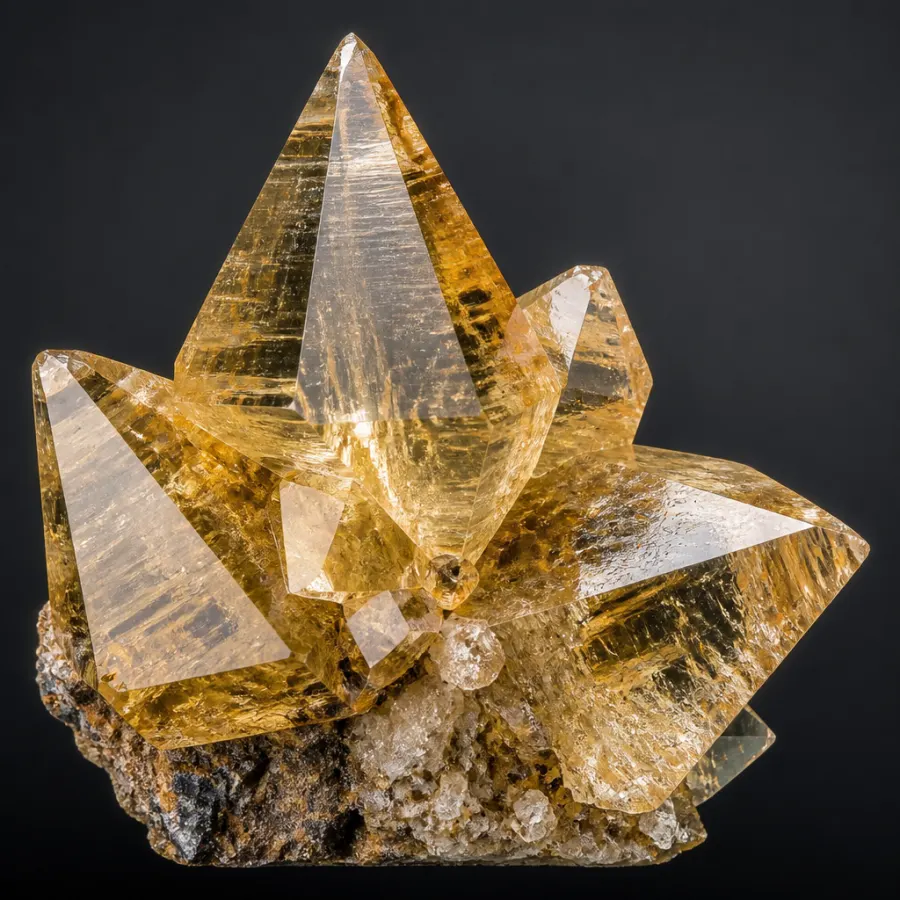
Calcite is calcium carbonate, CaCO3, grandfathered by the IMA (1836): hexagonal, hardness 3, measured density 2.7102, with perfect {10-11} rhombohedral cleavage. The Handbook records over 1000 crystal forms and crystals to 7 m. In this site's 176-sheet reference set, 60 other sheets name calcite as an associate, more than any other species.
In short
- The identity card: CaCO3, hexagonal, hardness 3, density 2.7102(2), perfect {10-11} cleavage, white streak, vitreous lustre, pearly on cleavages. The Handbook of Mineralogy sheet adds crystals to 7 m.
- The most-named associate in the set. Calcite appears in the Association field of 60 of the other 175 sheets in this site's reference set. Quartz is next at 50, then pyrite at 31 and malachite at 30. Method below.
- The largest form count printed. The sheet says over 1000 forms noted. Of the 11 sheets in the set that print a number of forms, the next are quartz (over 500), azurite (over 100) and baryte (over 70).
- Worked composition: CaCO3 is 40.04% calcium, 56.03% CaO and 43.97% CO2 by mass, which is the sheet's ideal column. Its Monterey Formation analysis recalculates to (Ca0.951Mg0.043Fe0.006)CO3.
- Calcite is the lightest of the five calcite-group sheets in the set. Measured density climbs with the cation with the cation: calcite 2.7102, magnesite 3.00, rhodochrosite 3.70, siderite 3.96, smithsonite 4.43.
| Species | Formula (Handbook) | Group on the sheet | Hardness | Density (measured) | Mass of 10 cm³ | Cleavage on the sheet |
|---|---|---|---|---|---|---|
| Calcite | CaCO3 | Calcite group | 3 | 2.7102 | 27.1 g | Perfect, rhombohedral {10-11} |
| Magnesite | MgCO3 | Calcite group | 3.5 to 4.5 | 3.00 | 30.0 g | Perfect, rhombohedral |
| Rhodochrosite | MnCO3 | Calcite group | 3.5 to 4 | 3.70 | 37.0 g | Perfect, rhombohedral |
| Siderite | FeCO3 | Calcite group | 3.75 to 4.25 | 3.96 | 39.6 g | Perfect, rhombohedral |
| Smithsonite | ZnCO3 | Calcite group | 4 to 4.5 | 4.43 | 44.3 g | Nearly perfect, rhombohedral |
| Dolomite | CaMg(CO3)2 | Dolomite group | 3.5 to 4 | 2.86 | 28.6 g | Perfect, rhombohedral |
| Aragonite | CaCO3 | Aragonite group | 3.5 to 4 | 2.95 | 29.5 g | {010} distinct; no rhombs |
What is calcite?
Calcite is calcium carbonate, CaCO3. The September 2026 IMA-CNMNC Master List writes it Ca(CO3) and records it as grandfathered, 1836, country unknown. The Handbook sheet puts it in the calcite group, calls it trimorphous with aragonite and vaterite, and says it forms a series with rhodochrosite. The name is from the Latin calx, for burnt lime, an allusion to an important commercial use.
It is hexagonal, point group -3 2/m and space group R-3c. The sheet reads: well-formed crystals are common, {10-11} rhombohedra, {21-31} scalenohedra and thin to thick tabular {0001}, with combinations of over 1000 forms noted, to 7 m. It also occurs granular, stalactitic, in concretions and massive. Twinning is on {01-12}, {10-11}, {0001} and {02-21}. Every four-index form on this page was read from the rendered PDF and satisfies h+k+i=0.
Hardness 3, measured density 2.7102(2), perfect {10-11} cleavage, conchoidal fracture, brittle. It is colourless or white, also grey, yellow, green and many other colors from included minerals, with a white streak and a vitreous lustre, pearly on cleavages and {0001}. It is uniaxial negative with ω 1.658 and ε 1.486. That gap is why clear calcite doubles a line seen through it; the working test is on how to tell calcite from quartz.
Why calcite turns up on so many other minerals' labels
Method. The Association field of each of the 176 sheets in this site's reference set was taken from its pdftotext -layout text. Each of the 176 species names was then searched for as a whole word, case-insensitively, in the other 175 fields (baryte also matched under its US spelling). No searched name contains a ligature. Every calcite hit was read in context: all 60 are list entries, including the metamorphic, blueschist and greenschist sub-lists.
Result: calcite is named on 60 sheets, the highest count of any of the 176 names. Quartz follows at 50, then pyrite 31, malachite 30, cerussite and dolomite 24 each, and azurite 18. Words that are not species names in the set, such as limonite, chlorite or zeolites, were not counted. The 60 run from the zeolites (stilbite, scolecite, heulandite) through the sulphides (galena, pyrite, stibnite) to the copper carbonates.
Calcite's own association line is split by setting: dolomite, celestine, fluorite, baryte, pyrite, marcasite and sphalerite in low-temperature veins; zeolites, chalcedony and “chlorite” in vesicles; talc, tremolite, grossular and quartz in metamorphic rocks; nepheline, diopside, apatite and orthoclase in igneous ones. The sheet calls it a major rock-forming mineral. When calcite is the part of a specimen you do not want, see how to remove calcite from a specimen, which gives no acid recipe and says why.
How many crystal forms does calcite have?
The sheet prints over 1000 forms noted. A search of all 176 sheets for a number next to the word forms finds 11 sheets that print a count. Ranked: calcite over 1000, quartz over 500, azurite over 100, baryte over 70, then anhydrite and brochantite about 40, vesuvianite up to 30 on one crystal, chalcanthite 25 other forms, antlerite twenty-odd, and anglesite and gypsum 20 or more others. Sheets that say only many forms are not ranked.
What the count means for identification: shape is a poor test and cleavage a good one. A mineral with over 1000 recorded forms can look like almost anything, from a thin tablet to a steep scalenohedron. What does not change is the break: calcite cleaves perfectly on the rhombohedron {10-11}. The rhomb test against aragonite, which shares the formula, is set out on is aragonite the same as calcite and not repeated here.
Against gypsum, the selenite question: gypsum is hardness 1.5 to 2 on its sheet, varying with direction, and calcite is 3, so calcite scratches gypsum and not the reverse. Gypsum is also 2.317 in density against calcite's 2.7102. The selenite pages are is selenite water soluble and why is my selenite turning yellow.
What is calcite made of? A worked composition
On standard atomic weights, CaCO3 has a formula mass of 100.086: 40.04% calcium, or as oxides CaO 56.03% and CO2 43.97%. Those two figures are exactly the sheet's ideal column (2).
The analysed calcite is from the Monterey Formation, California: CaO 53.60%, MgO 1.74%, FeO 0.43%, with CO2 44.22% calculated from stoichiometry, as the sheet notes. Divided by the oxide formula masses and set to one carbon, that is (Ca0.951Mg0.043Fe0.006)CO3, the cations summing to 1.000. About 4% of the calcium sites hold magnesium. The sheet does not describe this sample as magnesian calcite, and neither do we.
Density follows the cation. The five calcite-group sheets in the set share the CO3 unit and the rhombohedral cleavage. Their measured densities climb with the metal: calcium 2.7102, magnesium 3.00, manganese 3.70, iron 3.96, zinc 4.43. A 10 cm³ piece weighs 27.1 g as calcite and 44.3 g as smithsonite. That is why heft separates a white calcite from a white smithsonite when hardness barely does (3 against 4 to 4.5). The methods are on how to measure specific gravity at home.
Does calcite glow under UV, and where is it found?
The sheet says calcite may fluoresce red, blue, yellow, and other colors under either SW and LW UV, and records it as phosphorescent, cathodoluminescent, thermoluminescent and rarely triboluminescent. May is the operative word: fluorescence is not an identification test for calcite. Lamps are covered on fluorescent minerals explained.
The Handbook opens its distribution with abundant worldwide; a few of the many localities include, then, in order: the Helgustadanáma mine, Reydarfjord, Iceland; Alston Moor, Egremont and Frizington, Cumbria; Weardale, Durham; and Liskeard, Cornwall; St Andreasberg and Freiberg, Germany; Herja, Romania; Rossie and Balmat, New York; Hancock and the Phoenix mine, Michigan; Reynolds County and Joplin, Missouri, and Galena, Kansas, and Picher, Oklahoma, in the Tri-State district; the Elmwood mine, Tennessee; Bisbee, Arizona; Santa Eulalia, Guanajuato and Charcas, Mexico; Dal’negorsk, Russia; Tsumeb, Namibia; and the Mupine mine, Congo.
Locality pages: Alston Moor, Weardale, Dalnegorsk and Tsumeb. The other carbonates are indexed at the species index. We hold no catalogue and nothing here is offered for sale; the wanted list is the only commercial route.